For years, getting Bitcoin was a friction event. You had to find an exchange, pass KYC, wire money, and figure out custody. Most people didn’t bother. The ones who did often made life-changing returns.
Then 2024 happened.
BlackRock launched an ETF. Fidelity launched an ETF. Spot Bitcoin funds hit the market and absorbed more Bitcoin than was mined across the entire year. Today, buying Bitcoin is a three-tap process on your brokerage app. Your grandmother’s financial advisor can now put her in IBIT.
That’s great for Bitcoin adoption. And it’s exactly why the most sophisticated capital in the space has moved on to something harder to access: mining it.
The Market Changed. The Playbook Should Too.
When everyone can do something, the edge disappears. That’s not cynicism — it’s how markets work.
By mid-2025, roughly 59% of institutional investors were allocating at least 10% of their portfolios to Bitcoin and other digital assets. ETFs and corporate treasuries made it happen. Bitcoin is no longer a fringe asset. It’s increasingly a core allocation sitting in the same breath as equities and bonds.
Which means if you’re buying Bitcoin on an exchange today, you’re doing what everyone else is doing. Same exposure, same market price, same upside ceiling as every other buyer who hit the button that morning.
The smart money noticed this. According to RSM US, as mining stock valuations declined and spot Bitcoin ETFs launched, institutional investors became more selective — focusing less on raw operational metrics and more on long-term fundamentals like operational resilience, treasury strategy, and risk management. The conversation shifted from “how do we get Bitcoin exposure” to “how do we get an edge on the infrastructure that produces it.”
That’s a different question. And it leads somewhere most retail investors haven’t gone yet.
What Mining Actually Does That Buying Can’t
Here’s the structural difference most people miss.
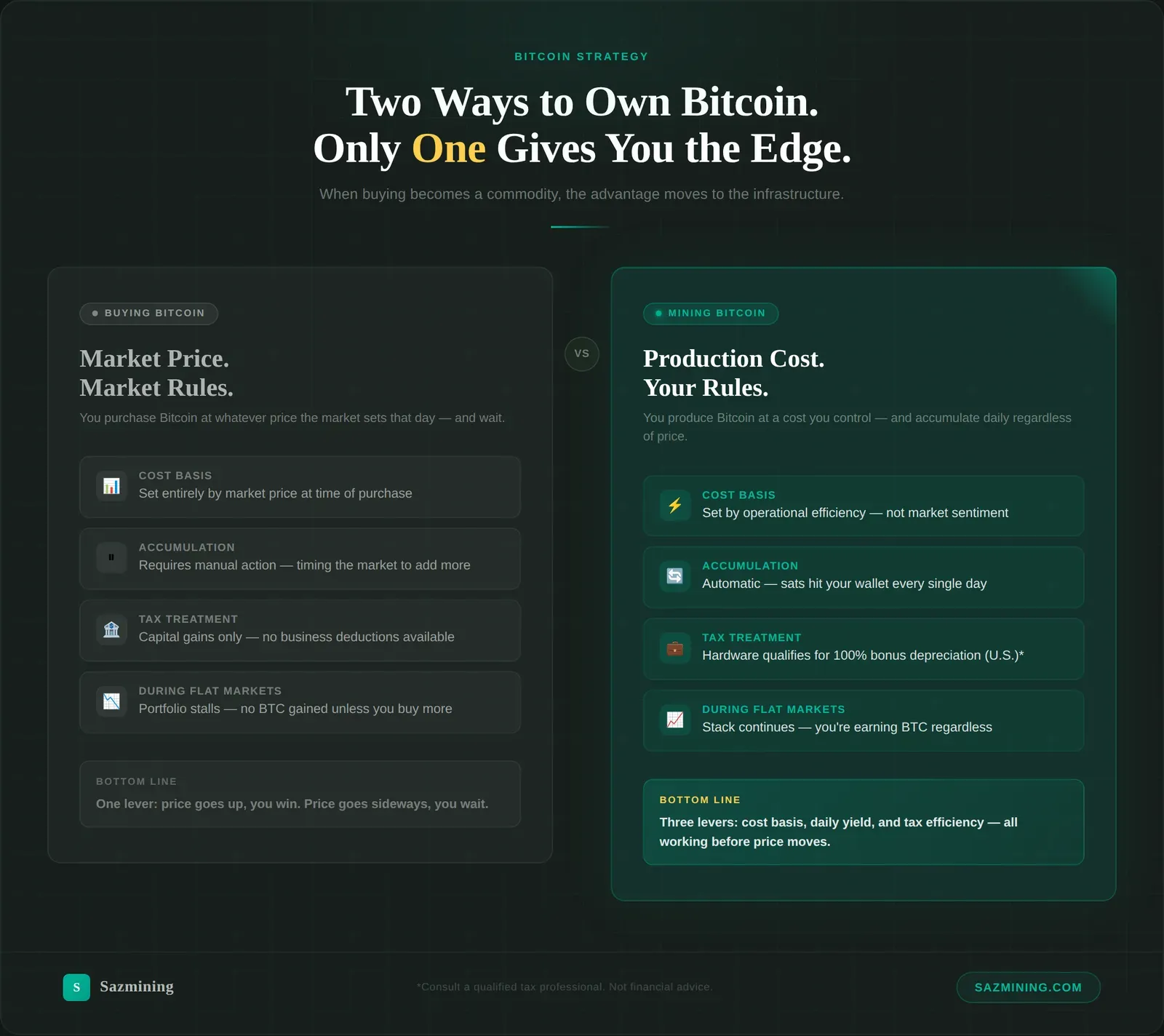
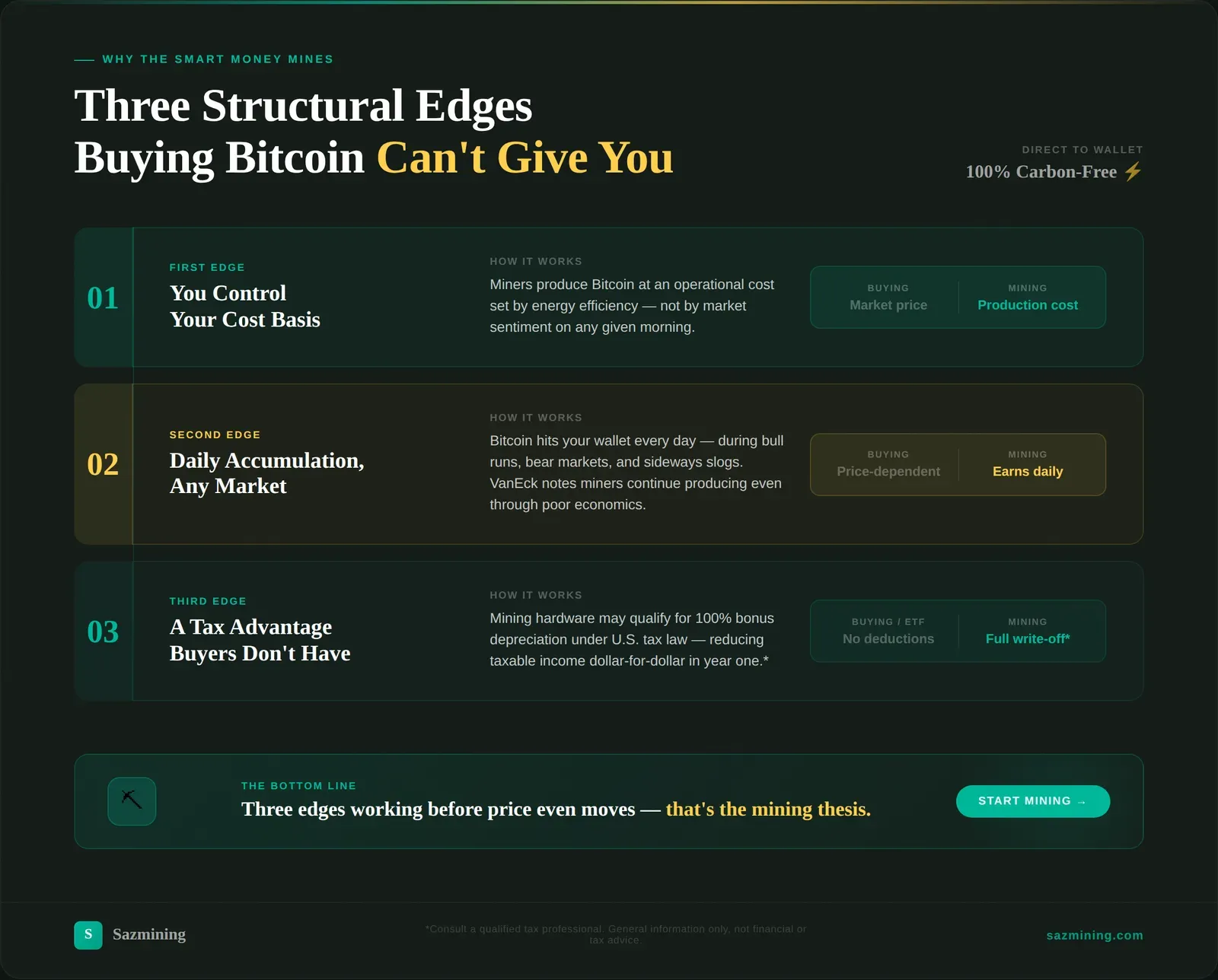
When you buy Bitcoin, you’re purchasing it at whatever the market has decided it’s worth in that moment. You need price to go up to win. One variable. One lever.
When you mine Bitcoin, you’re producing it at a cost. That cost, when managed properly, sits below market price. You’re not waiting for the market to reward you. You’re generating Bitcoin daily, depositing it directly to your wallet, and accumulating at a cost basis the market doesn’t control.
VanEck’s research team noted this dynamic directly: many entities continue to mine despite periods of poor economics because they believe in Bitcoin’s future. That’s not stubbornness — it’s a structural advantage buyers simply don’t have. When Bitcoin goes sideways for six months, a buyer’s portfolio goes sideways with it. A miner keeps stacking sats. Same asset, fundamentally different relationship to it.
This is why VanEck’s analysis found that forward returns are historically more likely to be positive following periods of hash rate contraction — the miners who kept producing through hard stretches are already positioned when the price moves.
The Tax Angle Nobody Talks About
There’s a third dimension to this that almost never makes it into Bitcoin content: taxes.
Under current U.S. tax law, mining hardware qualifies for 100% bonus depreciation when placed in service — a write-off unavailable through spot BTC or ETF purchases. According to TokenTax, business miners can list gross mining receipts on Schedule C and deduct ordinary and necessary expenses, including hardware depreciation and electricity costs. Spot buyers get none of this. ETF holders get none of this.
When you own the infrastructure that produces your Bitcoin, you’re operating as a business, not just an investor — and the tax code treats you accordingly. A meaningful hardware investment could be written off entirely in year one, reducing taxable income dollar for dollar while your machines are producing Bitcoin daily.
This isn’t a loophole. It’s the same depreciation treatment any capital-intensive business uses. The difference is that most people have never thought about their Bitcoin strategy in those terms. High earners, business owners, and anyone with significant taxable income have a structural reason to mine that has nothing to do with Bitcoin’s price on any given Tuesday.
Why Sazmining Specifically
The mining thesis only works if the operation works. Cheap power, reliable uptime, and renewable energy aren’t nice-to-haves — they’re what determines whether you’re producing Bitcoin at a competitive cost or burning money chasing a trade.
Sazmining runs facilities in Paraguay and Norway, all powered by 100% carbon-free hydro energy. Your rigs are customer-owned and pay out directly to your wallet. No fund structure sitting between you and your Bitcoin. No rental model where someone else controls the yield. Just your machines, your coins, your custody.
325+ customers. 3,000+ rigs across 17.5 MW of capacity. A 90% uptime guarantee. Those aren’t marketing numbers — they’re the operational baseline that determines whether your mining thesis actually plays out.
The Bottom Line
Bitcoin buying has been democratized. That’s good. It’s also made the purchase itself a commodity.
Mining remains harder to access, harder to understand, and harder to execute well without the right partner. That’s what keeps the edge intact for people who take the time to do it properly.
If you’re serious about Bitcoin, you’re already thinking about accumulation, cost basis, and long-term positioning. Mining isn’t a replacement for owning Bitcoin — it’s a different way to earn it, one that doesn’t require you to time the market, because the market isn’t the point.
The sats hit your wallet every day, whether Bitcoin is making headlines or not → explore Sazmining’s rigs and run your own numbers.
The tax benefits described above are general in nature and depend on individual circumstances. Always consult a qualified tax professional before making decisions based on tax strategy.
Sources: