You Have Bitcoin. Or Do You?
You signed up for an account. You bought Bitcoin. You watched the price move. Your portfolio balance went up.
That feels like ownership. It isn’t.
When you buy Bitcoin on an exchange like Coinbase, Kraken, or Binance, you receive a credit on that company’s internal ledger. You do not receive Bitcoin. You receive a promise that they will give you Bitcoin if you ask for it.
That is a meaningful distinction — and it has ended people’s savings more than once.
The Hard Truth
“Not your keys, not your coins” is not a cliche. It is a precise technical statement. If someone else controls the private keys to a Bitcoin wallet, they control the Bitcoin in it. You have a claim. A claim is not the same as ownership.
What Happens When the Promise Breaks
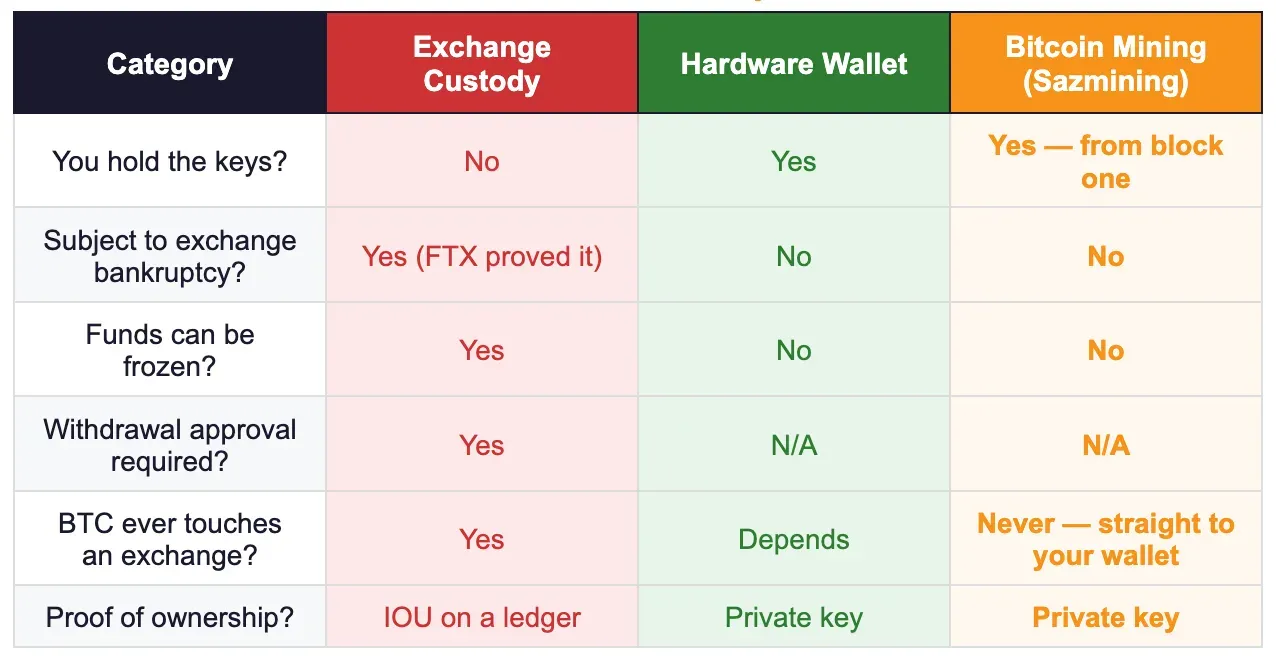
In November 2022, FTX — at the time the second-largest crypto exchange in the world — collapsed. It owed customers billions it did not have. Withdrawal requests were frozen. Customer funds had been used to cover other bets without their knowledge.
Customers who held Bitcoin on FTX did not lose their Bitcoin because of a hack. They lost it because they never had it.
FTX is the most famous example, but not the only one. Mt. Gox (2014), Celsius (2022), and Voyager (2022) followed similar patterns. In each case, users who believed they held Bitcoin were left with bankruptcy claims instead.
Exchange custody carries platform risk. If the exchange is insolvent, hacked, or regulated out of existence, your access to the Bitcoin in your account depends entirely on how the exchange resolves that situation. You have no say in the process.
What Self-Custody Actually Means
Bitcoin is secured by cryptography. Every Bitcoin wallet has two components: a public address and a private key. The public address is where Bitcoin is received. The private key is what authorizes Bitcoin to be moved.
True ownership means you hold the private key. No one else can move your Bitcoin without it.
Self-custody does not mean your Bitcoin lives in a physical object. It means the key that controls it is under your control — not stored on a server you do not own, operated by a company you cannot audit.
Key Fact
There are approximately 21 million Bitcoin that will ever exist. Of those, an estimated 3 to 4 million are permanently lost — often because someone lost access to their private keys. That number grows every year. Private key security is not optional.
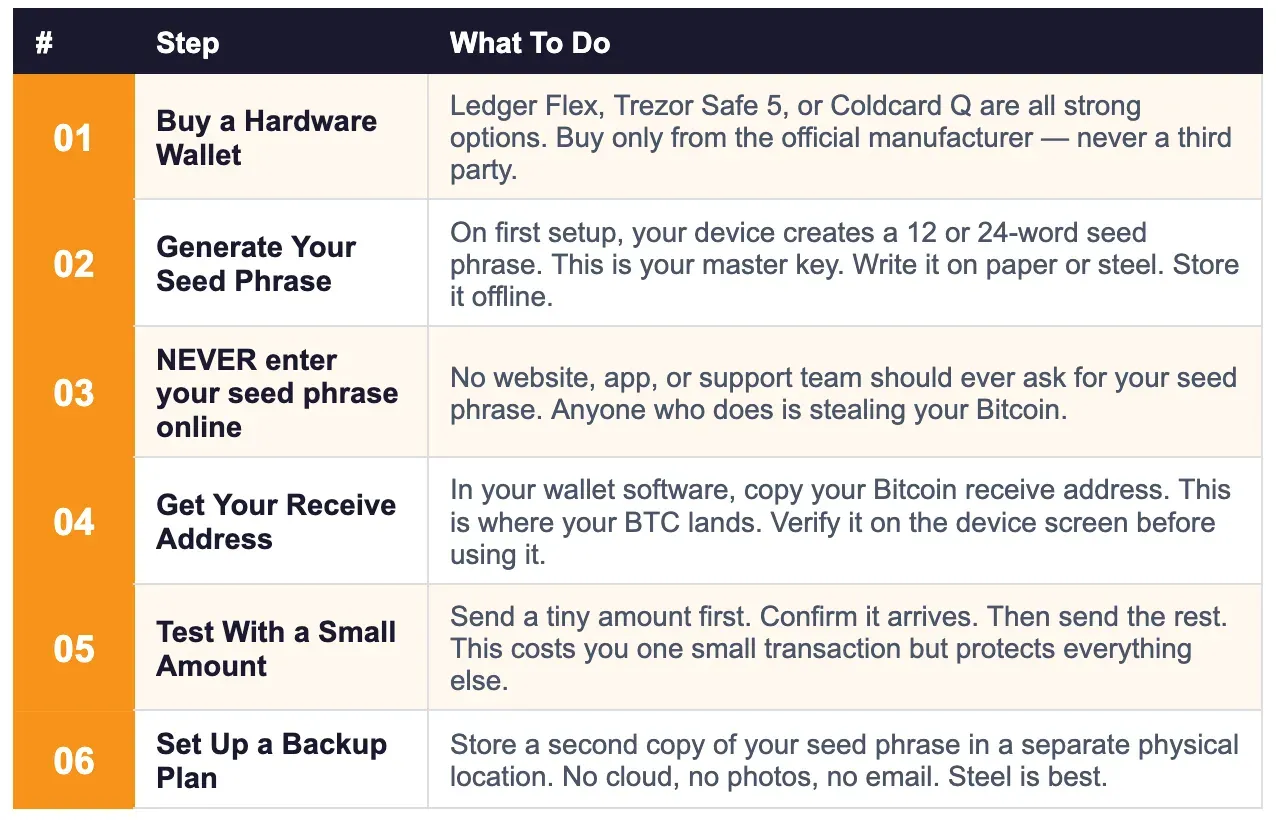
Hardware Wallets: The Basics
A hardware wallet is a small physical device that stores your private key offline. Because the key never touches an internet-connected device, it cannot be stolen remotely.
Common options:
- Ledger Flex — Touch screen, mobile-compatible, strong ecosystem support
- Trezor Safe 5 — Open-source firmware, straightforward interface
- Coldcard Q — Air-gapped, no USB required, preferred by high-security users
All three do the same core job: keep your private key offline and require physical confirmation before any transaction is signed.
Other Risks Most People Overlook
Exchange bankruptcy is the worst-case scenario, but it is not the only way exchange custody fails you.
Withdrawal Freezes
Exchanges can restrict or pause withdrawals at any time. This has happened during periods of market volatility, regulatory pressure, and banking failures — events when you are most likely to want your Bitcoin.
Identity Exposure
To use a major exchange, you submit government ID and sometimes more. That information is stored in a database. Exchanges have been breached. Regulatory subpoenas compel disclosure. Your Bitcoin activity becomes visible to third parties you did not choose.
Account Termination
Exchanges can close your account. Reasons range from compliance flags to geographic restrictions to platform policy changes. If your account is terminated while your Bitcoin is on it, recovery is slow and sometimes unsuccessful.
IOUs Are Counterparty Debt
When you deposit Bitcoin on an exchange, you are extending credit to that exchange. You become an unsecured creditor. In a bankruptcy, unsecured creditors are last in line.
Consider This
Every dollar held in your brokerage account is protected up to $500,000 by SIPC insurance. Bitcoin held on an exchange carries no equivalent federal protection. You are taking counterparty risk on a private company.
Mining: The Only Route Where Bitcoin Never Touches an Exchange
There is one path to accumulating Bitcoin where exchange custody is never part of the equation: mining.
When you mine Bitcoin, the network pays you directly. With Sazmining, payouts go straight to your wallet — the wallet you control, with the private key you hold. Your Bitcoin is never pooled on a platform. It never passes through an intermediary’s hands.
That is not a feature. That is the design.
The Sazmining model is built around direct ownership. You buy mining capacity. Your rigs run at our data centers in Paraguay and Norway — all powered by renewable energy. Every sat you earn lands in your wallet, on your terms.
Why Custody Matters More Now Than It Did Five Years Ago
Bitcoin’s supply is fixed. The 2024 halving reduced the block subsidy to 3.125 BTC per block. Future halvings continue that reduction. As supply growth slows, each coin becomes harder to replace.
In that context, losing Bitcoin to an exchange failure is not a setback. It is a permanent loss of a finite, irreplaceable asset. The stack you build over years cannot be rebuilt just by buying more — not at the same price, not with the same unit economics.
Real custody does not require paranoia. It requires understanding what you own, who controls it, and what could go wrong. Once you understand those three things, self-custody is not complicated — it is obvious.
The Bottom Line
An exchange balance looks like Bitcoin. It behaves like Bitcoin. But it is a claim on Bitcoin held by a company that may or may not honor that claim when you need it most.
Hardware wallets are not for advanced users. They are the minimum standard for anyone serious about holding Bitcoin.
And if you want to skip the exchange entirely — to acquire Bitcoin that is yours from the first block — mining is the path.
Sazmining exists to make that path accessible. Your hardware, our data centers, your wallet. That’s aligned incentives.
Ready to mine directly to your wallet?
Visit our store to see current mining plans and start stacking wild sats — straight to cold storage!