For decades, real estate was the default answer for building generational wealth.
Buy property, collect rent, wait for appreciation - seems easy, right?
But a new category of hard-asset investing has quietly developed the same foundational properties — ownership, cash flow, appreciation, and finite supply — while eliminating the debt and landlord headaches. That category is Bitcoin mining.
“Own the asset that produces the asset. That’s the real estate principle — and it’s exactly what Bitcoin mining does.”
The Ownership Parallel
Real estate investing is fundamentally about ownership. When you buy a rental property, you control a physical asset that generates income, appreciates over time, and cannot be inflated away. Bitcoin mining offers a structurally identical proposition in the digital realm. Purchase an ASIC rig, host it at a professional facility, and it earns Bitcoin that gets paid directly to your wallet — no custody, no intermediary. You control the private keys. You receive what the industry calls “wild sats”: uncut Bitcoin sent straight to you on every payout cycle.
The parallel to rental income is direct. A landlord owns a building; tenants pay rent; the building appreciates. A miner owns a rig; the Bitcoin network pays block rewards; the underlying asset appreciates. Both models reward patient owners who bought into a scarce, productive asset early.
What the Numbers Say
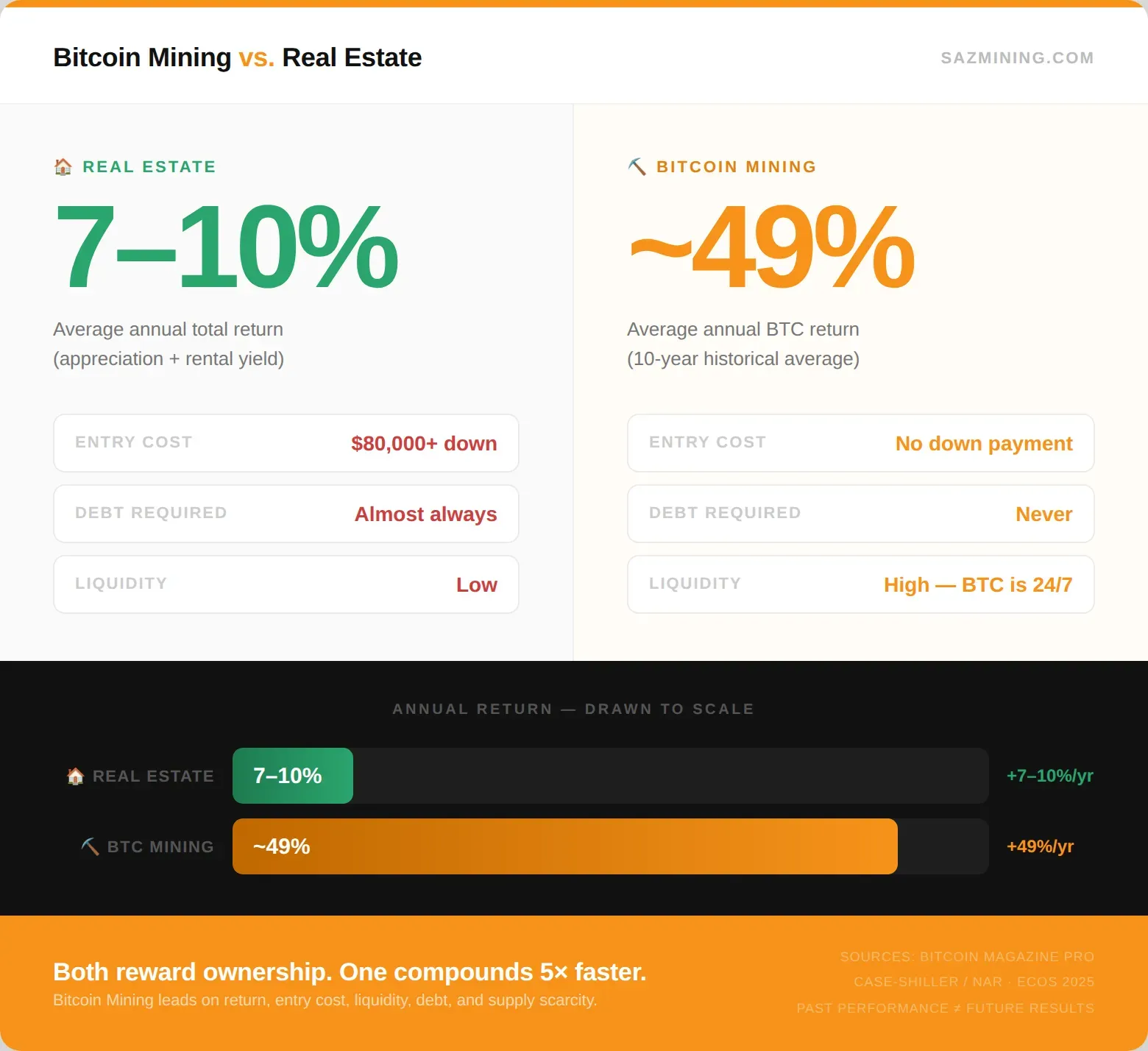
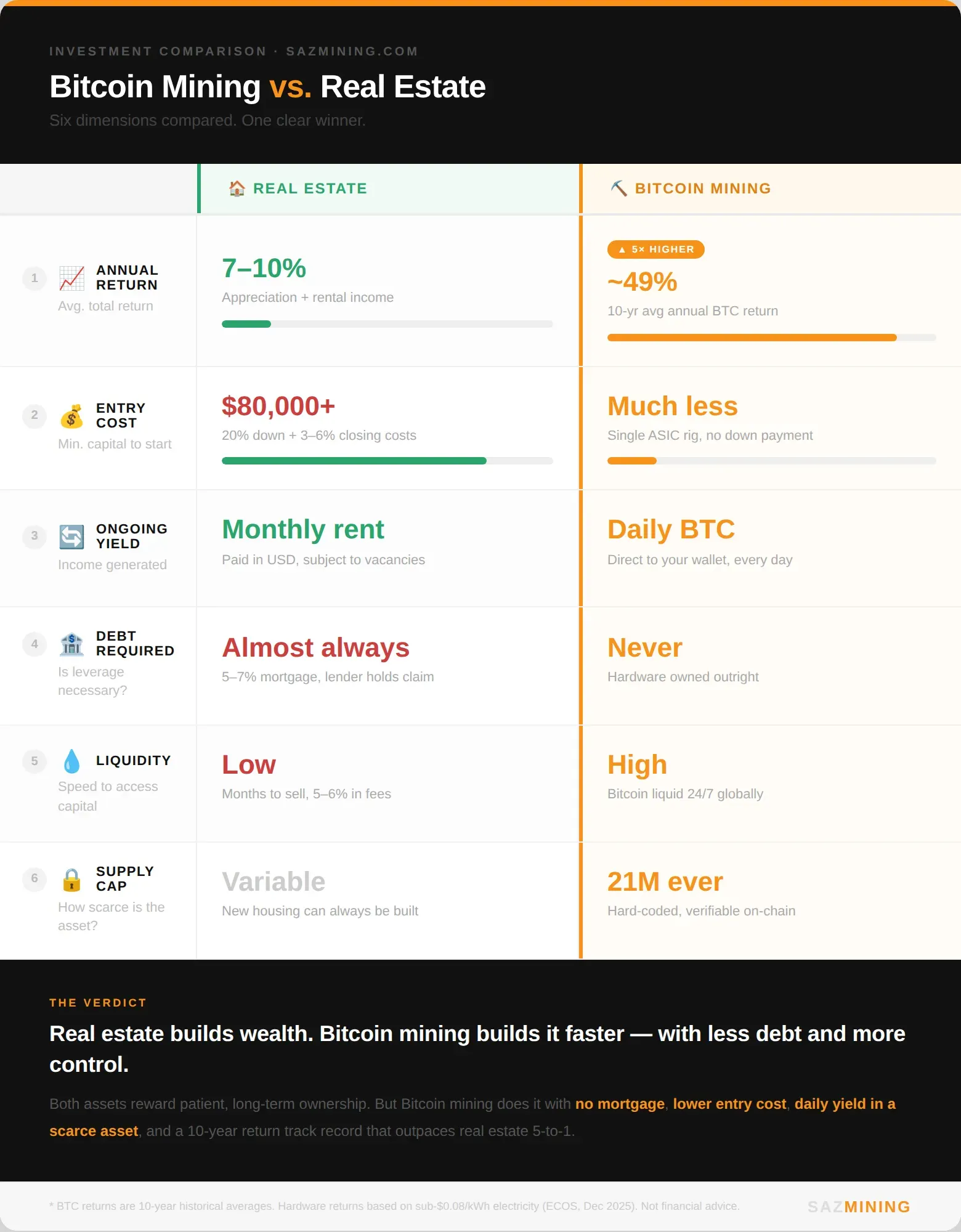
U.S. real estate has historically returned 7 to 10 percent annually when rental yields are included. Those are solid numbers — and the baseline against which Bitcoin’s performance looks extraordinary. Bitcoin has delivered an average annual return of approximately 49 percent over the past ten years, outpacing real estate, gold, bonds, and the S&P 500 by a wide margin [1]. A 2026 comparison found Bitcoin outperformed real estate in four of the last five calendar years [2].
For miners specifically, operations running below $0.08 per kilowatt-hour with current-generation hardware can target 12- to 18-month payback periods and annual returns of 60 to 80 percent on hardware investment [3]. Sazmining’s facilities in Paraguay and Norway run on renewable energy at rates as low as $0.056 per kilowatt-hour — placing our customers firmly in the profitable tier.
Where Mining Has the Edge
Strip away the jargon, and three structural advantages emerge:
- No debt required. Most real estate investors finance 80 percent of their purchase. Mining requires no leverage — you buy hardware and own it outright, with no lender holding a claim on your assets.
- Liquidity. Selling a rental property takes months and costs 5 to 6 percent. Bitcoin is liquid 24 hours a day, globally, with no escrow agents or title companies.
- Yield denominated in a scarce asset. Rental income is paid in dollars. Mining yield is paid in Bitcoin — an asset with a hard cap of 21 million coins. For long-term holders, that distinction compounds.
The Honest Tradeoffs
Real estate provides utility — land and buildings have physical value regardless of market sentiment. It also benefits from significant tax advantages: mortgage interest deductions, 1031 exchanges, and depreciation schedules that Bitcoin mining’s regulatory framework does not yet match. And Bitcoin’s volatility is real. The 49 percent average annual return comes with significant swings in both directions. The data rewards patient, multi-year holders — the same discipline that makes real estate work.
Mining as a Service: The Property Manager Model
Most rental property owners do not personally fix broken pipes — they hire a property manager. Sazmining plays exactly this role for Bitcoin miners. Customers purchase ASIC hardware; Sazmining hosts it in renewable-energy data centers and handles power, cooling, maintenance, and 24/7 monitoring. Bitcoin earned goes directly to the customer’s wallet via Luxor or OCEAN mining pools — no custody, no intermediary. With 3,000-plus rigs across 325-plus customers and a 90 percent uptime guarantee, the model scales.
“Mining is not for investors who need to sell tomorrow. It’s for those who want to stack a hard, scarce asset over years — the same patience real estate rewards.”
Bottom Line
Real estate and Bitcoin mining are two expressions of the same wealth-building instinct: own the asset that produces the asset, let it compound, and avoid dilution from inflation. The difference is that Bitcoin mining does it with less debt, more liquidity, lower entry cost, and an underlying asset whose 15-year return record is unlike anything real estate has produced. If you have built wealth through property ownership, you already understand the core principle.