Bitcoin is no longer a fringe topic.
It is now part of the global conversation around money, power, sanctions, censorship, and sovereignty. That was the backdrop for Kent Halliburton’s latest appearance on Simply Bitcoin, where he joined Nico and Opti to break down Bitcoin’s role in geopolitics, the resilience of mining, and why bear markets can be the moments that separate short-term tourists from long-term Bitcoiners.
The conversation started with headlines around the U.S. Treasury, Iranian digital asset exchanges, and speculation over whether geopolitical conflict may be connected to Bitcoin market volatility.
But the deeper theme was much bigger than one headline.
The real takeaway was this:
When financial rails become political tools, Bitcoin mining becomes more than an accumulation strategy. It becomes a way to access the Bitcoin network directly.
Bitcoin is now part of the geopolitical conversation
The Simply Bitcoin crew opened the episode by discussing recent U.S. Treasury action against Iranian digital asset exchanges and the role Bitcoin now plays in global finance.
Whether governments like it or not, Bitcoin has entered the arena.
It is being discussed alongside sanctions, military conflict, international payments, sovereign reserves, stablecoins, and financial censorship. That does not mean every headline gets the details right. In fact, one of Kent’s key points was that the phrase “digital assets” often muddies the waters.
Stablecoins and Bitcoin are not the same thing.
Stablecoins can be issued, frozen, controlled, and censored by centralized entities. Bitcoin works differently. In self-custody, Bitcoin does not depend on a bank, an exchange, or a government-controlled payment network.
That distinction matters.
As Kent explained during the conversation, claims about seizing “digital assets” can create the impression that Bitcoin itself was somehow stopped or controlled. But unless Bitcoin is sitting on an exchange or controlled by someone else’s keys, it is not the same kind of asset.
That is why the old Bitcoiner phrase still matters:
Not your keys, not your coins.
The global hash war is already here
One of the strongest parts of the conversation centered on mining.
Nico brought up the idea of a “global hash war,” where countries, companies, and individuals compete to produce Bitcoin by contributing hashrate to the network.
Kent agreed with the framing, but added an important twist.
If a country, company, or individual wants to send value without depending on another government or financial institution, Bitcoin is the most reliable tool available. But if they want to do that at the deepest level, they need to be able to produce blocks.
Bitcoin produces roughly 144 blocks per day. Kent pointed out that if someone controls enough hashrate to produce even one block per day, they have a direct way to move value through the Bitcoin network.
That is not just a technical point.
It is a sovereignty point.
Mining is not only about earning sats. It is about participating in the production of blocks. It is about strengthening the network. And it is about accessing Bitcoin at the source instead of waiting for permission from an exchange, bank, or payment provider.
This is why mining continues even under pressure.
China banned mining. Bitcoin kept producing blocks.
Governments criticize Bitcoin. Bitcoin keeps producing blocks.
Markets crash. Bitcoin keeps producing blocks.
That is the power of the network.
Bear markets test conviction
The conversation also turned to Bitcoin’s price action and the emotional weight of bear markets.
Anyone who has been in Bitcoin long enough knows the feeling. The sentiment changes. The tourists disappear. People who were euphoric at the top start asking whether it is all over.
Kent acknowledged that the current environment has been painful. Bitcoiners feel it. Miners feel it. Companies feel it.
But that is also the point.
Bear markets reveal who is here for the right reasons.
During periods of fear, the flashy narratives fade away. What remains is the network, the fixed supply, the difficulty adjustment, the miners, the nodes, and the people who continue building because they understand why Bitcoin exists.
Nico framed moments like this as the time when people can either panic or continue stacking. Kent added that historically, the most uncomfortable periods have often been the moments that rewarded long-term conviction.
That does not mean mining is risk-free. Bitcoin mining involves hardware costs, electricity costs, changing market conditions, and operational realities.
But it does mean the opportunity should be viewed through a long-term lens.
For people who understand Bitcoin, the question is not only, “What is the price today?”
The better question is:
How do I want to acquire Bitcoin over time?
Why mining is different from buying Bitcoin on an exchange
That question led directly into Kent’s explanation of Sazmining.
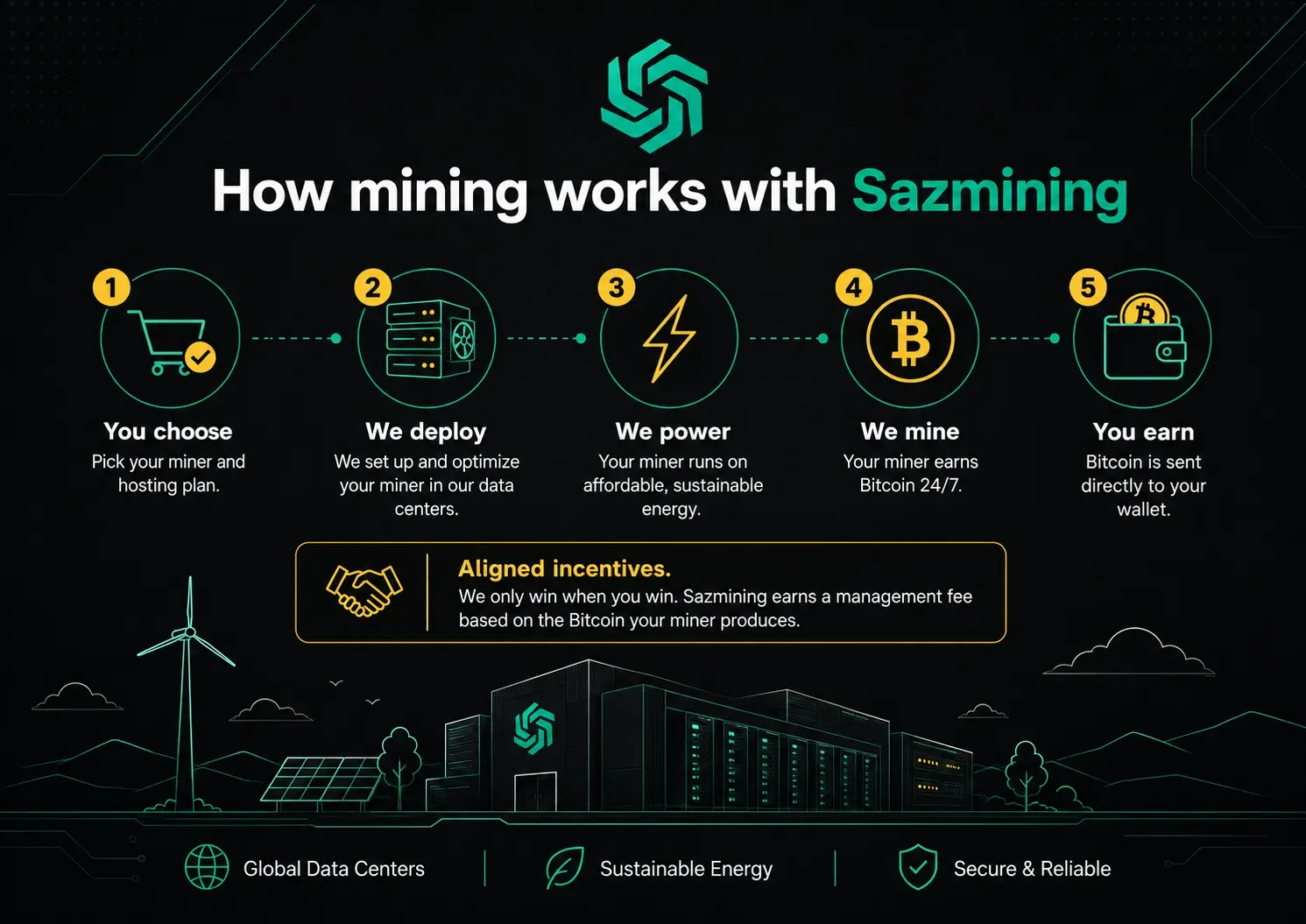
Sazmining is a managed mining service. Kent described it like a property management model for Bitcoin mining. Clients own the mining hardware, pay for the electricity, and Sazmining manages the operational side.
The key distinction is incentive alignment.
Sazmining does not profit from marking up electricity. Sazmining does not build its business around selling clients overpriced hardware. Instead, the company earns a management fee based on the Bitcoin produced by clients’ machines.
In other words, Sazmining only does well when its clients’ miners are producing Bitcoin.
That is a fundamentally different model from many businesses in the Bitcoin ecosystem.
Exchanges profit when people trade.
Custodians profit when people leave assets on platform.
Sazmining earns by helping clients mine Bitcoin.
That alignment matters because mining is operationally complex. Most people do not want to source machines, negotiate power, manage firmware, deal with heat, monitor uptime, troubleshoot issues, or coordinate data center logistics.
Sazmining handles that complexity so clients can access Bitcoin mining without becoming full-time mining operators.
Wild sats come directly from the network
The most important part of Kent’s message was not just that mining can be simplified.
It was that mining creates a different kind of Bitcoin experience.
When someone buys Bitcoin on an exchange, they are converting fiat into Bitcoin through a financial intermediary. That may be convenient, but it also means going through the traditional system first.
Mining is different.
With mining, Bitcoin is produced directly from the network and sent to the miner’s wallet.
At Sazmining, we call these wild sats.
Wild sats are not bought from an exchange order book. They are not acquired from someone else’s sell order. They are earned through proof of work.
That is how Satoshi originally designed Bitcoin to be acquired.
In the early years, Bitcoiners mined their coins. Over time, exchanges became the default path for most people. Kent’s point is that Sazmining is helping bring back a more direct, sovereign way to accumulate Bitcoin.
Not by asking every Bitcoiner to become a data center operator.
But by making managed mining accessible.
Mining is a physical business in a digital world
Another powerful theme from the episode was the physical nature of mining.
Bitcoin is digital money, but mining is grounded in the real world.
It requires machines.
It requires energy.
It requires infrastructure.
It requires operational discipline.
That makes mining very different from financial speculation. There is a real machine doing real work, consuming real energy, and contributing to the security of a real monetary network.
Kent compared Sazmining’s model to Airbnb in the sense that Sazmining manages infrastructure on behalf of clients. The client owns the productive asset. Sazmining manages the operational environment. The result is a more accessible way to participate in Bitcoin mining.
That physical reality is part of what makes mining powerful.
Bitcoin is not just a ticker on a screen.
It is a global network secured by energy, hardware, and human incentives.
The incentive structure is the innovation
Bitcoin works because it aligns incentives.
Miners act in their own self-interest by securing the network and earning Bitcoin. Node runners act in their own self-interest by verifying the rules. Holders act in their own self-interest by preserving purchasing power. The network benefits because each participant is incentivized to protect the system.
Kent made the same point about Sazmining’s business model.
If clients win, Sazmining wins.
If miners are not producing, Sazmining is not earning its management fee.
That is the kind of incentive structure Bitcoiners should pay attention to.
In a world full of platforms that profit whether users win or lose, aligned incentives are not just nice to have. They are the whole game.
The bottom line
Kent’s latest Simply Bitcoin appearance was not just a conversation about price, politics, or mining.
It was a reminder of why Bitcoin matters.
When governments weaponize financial rails, Bitcoin keeps producing blocks.
When markets panic, Bitcoin keeps producing blocks.
When headlines blur the difference between Bitcoin and “digital assets,” Bitcoin keeps producing blocks.
And when people want a more direct way to accumulate Bitcoin, mining remains one of the most powerful paths available.
Buying Bitcoin on an exchange may be easy.
Mining Bitcoin connects you to the network itself.
That is the difference.
That is why wild sats matter.
And that is why Sazmining exists.
Start mining wild sats
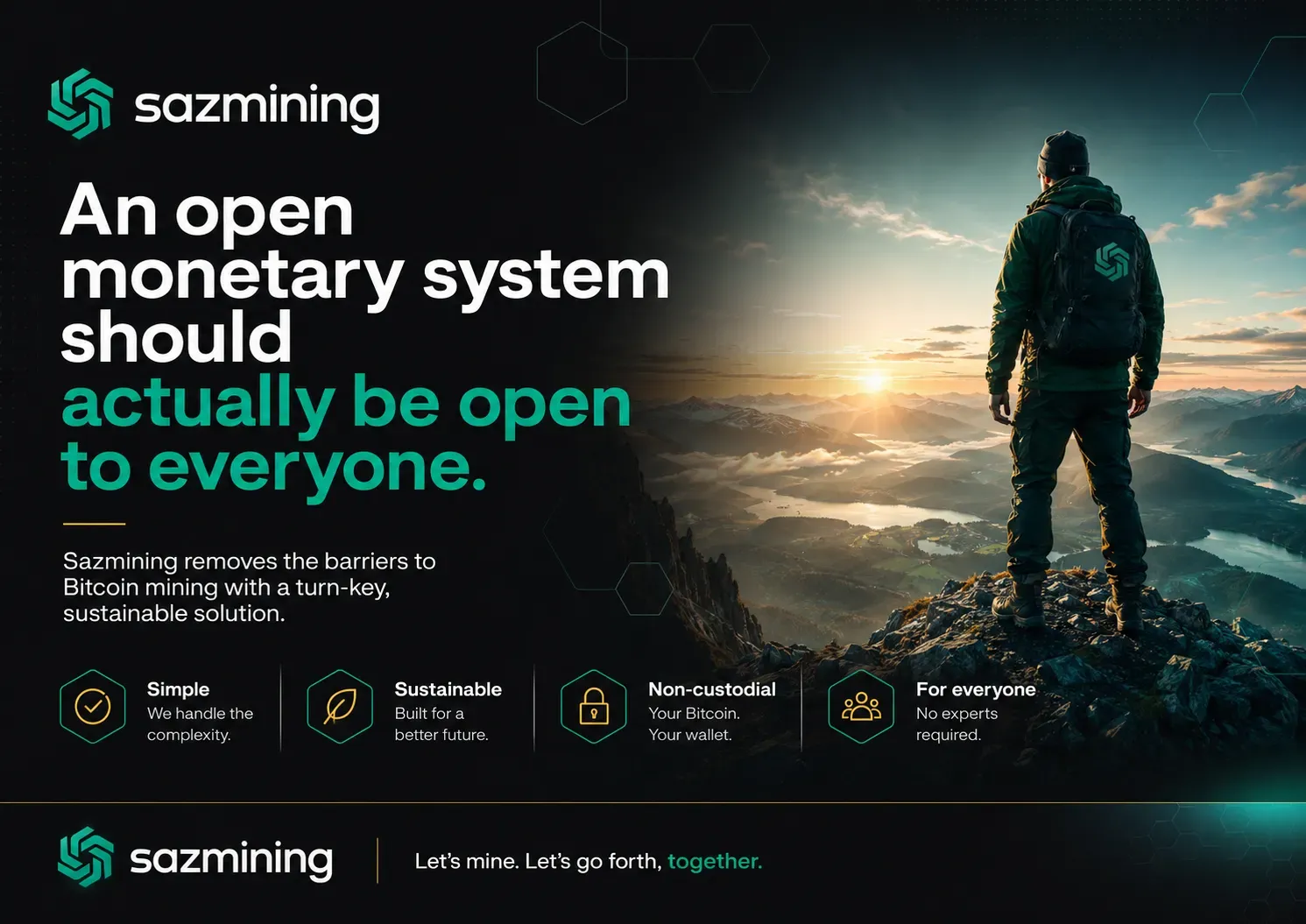
Sazmining helps clients mine Bitcoin without the technical headache.
You buy the rig. You pay for electricity. We manage the mining operations. Your Bitcoin goes directly to your wallet.
Simply Bitcoin listeners can visit:https://deals.sazmining.com/simplybitcoin/
Use promo code SIMPLY for $100 off any rig(s)!