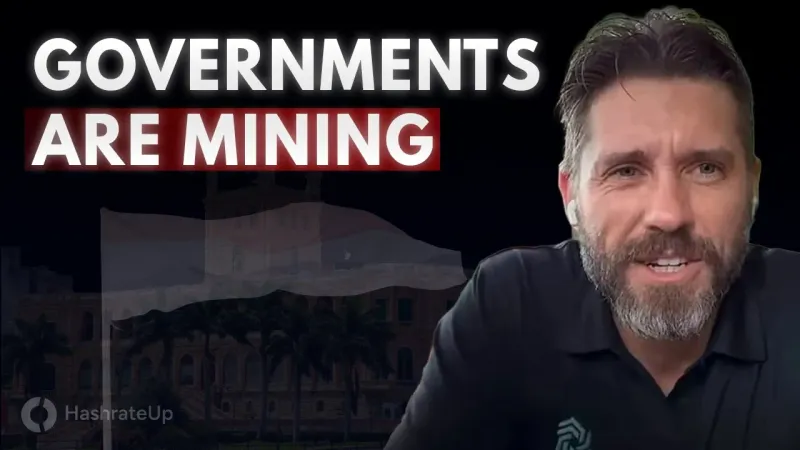
This week, our CEO Kent Halliburton joined Simply Bitcoin to talk about something we wish more people understood clearly:
Bitcoin mining is not a hype trade. It’s a long-term savings strategy.
As 2026 begins, the headlines are getting louder, institutions are getting more direct, and Bitcoin’s supply math remains brutally simple. Here’s what we covered and why it matters for anyone considering their first rig (or their next one).
1) Morgan Stanley’s spot Bitcoin ETF is a real signal (especially “in-kind”)
One of the key stories discussed was Morgan Stanley seeking SEC approval for a spot Bitcoin ETF, with shares created and redeemed in large blocks by authorized participants either in cash or in kind.
That “in-kind” detail matters because it points toward a more direct relationship with actual bitcoin in the plumbing of the product, rather than everything being purely cash-settled or derivative-based.
We’re not here to tell you ETFs are “good” or “bad.” We’re here to say this:
Institutions adapting their products is a sign they can’t ignore Bitcoin anymore.
And when large players compete to offer access, the long-term impact tends to be upward pressure on demand.
2) The supply math is still the most underrated part of the entire story
Kent put it plainly on the show:
- 3.125 BTC per block
- A block about every 10 minutes
- Roughly 450 BTC per day entering the market
That’s the daily “new supply” the world has to absorb before you even start talking about net new demand.
Whatever your view on ETFs, whatever your view on institutions, this part doesn’t change.
3) The core idea: mining is “energy-cost averaging” into a Bitcoin position
Here’s the reframe Kent shared that we think is the most useful for everyday Bitcoiners:
Mining can be viewed as an opportunity to energy-cost average into a Bitcoin position over a multi-year window.
The logic is straightforward:
- You pay an electric bill every month
- Your miner produces sats every day as it contributes hashpower via a pool
- Divide your monthly cost by sats earned, and you get an implied “dollar per bitcoin” cost basis (your energy-cost average price)
Kent shared that, in a couple of current Saz offerings (including Paraguay), that implied cost basis was roughly $50,000 to $64,000 at the time of the conversation.
The takeaway is not “guaranteed profit.” The takeaway is that mining gives you a framework to evaluate stacking sats as a production strategy, not a trading strategy.
4) Why we think this matters more in 2026
If institutions increasingly “compete” for Bitcoin exposure, the smartest move for individuals is to keep the basics tight:
- Prioritize sovereignty
- Understand the supply math
- Stack with a plan you can sustain
Mining fits this mindset because it turns your strategy into something you can do consistently: plug in, keep it running, and accumulate over time.
5) If you’re considering a rig, here’s the simplest way to think about it
When you evaluate mining, we’d encourage you to ask three questions:
- What’s my all-in monthly cost? (power + management + whatever applies)
- How many sats do I expect to produce monthly? (based on current network conditions)
- What’s my implied cost basis vs. buying on an exchange?
That’s the mental model Kent used to help a client recalibrate expectations after ~18 months, and it’s one we use internally because it stays grounded.
Ready to start stacking wild sats?
If you want to explore mining as a long-term savings strategy (first rig or expansion), we’ll help you map out an approach that fits your goals and your timeline.
Plug in. Stay consistent. Stack wild sats.