Bitcoin is trading around $70,000. Hashprice just crashed from $70 to $35. Mining difficulty dropped 11% last weekend, the largest decline since China’s 2021 mining ban. Headlines are screaming about miner capitulation.
And if you’re still mining? Congrats, you’re exactly where you want to be.
Here’s what the panicking crowd doesn’t understand: the halving isn’t a threat to long-term miners. It’s a filter. And the sats you’re accumulating right now, during the pain, are some of the most valuable you’ll ever own.
The Math That Changes Everything
Yes, the April 2024 halving cut block rewards from 6.25 BTC to 3.125 BTC. Half the sats, right?
Wrong framing.
Look at what happened after every previous halving:
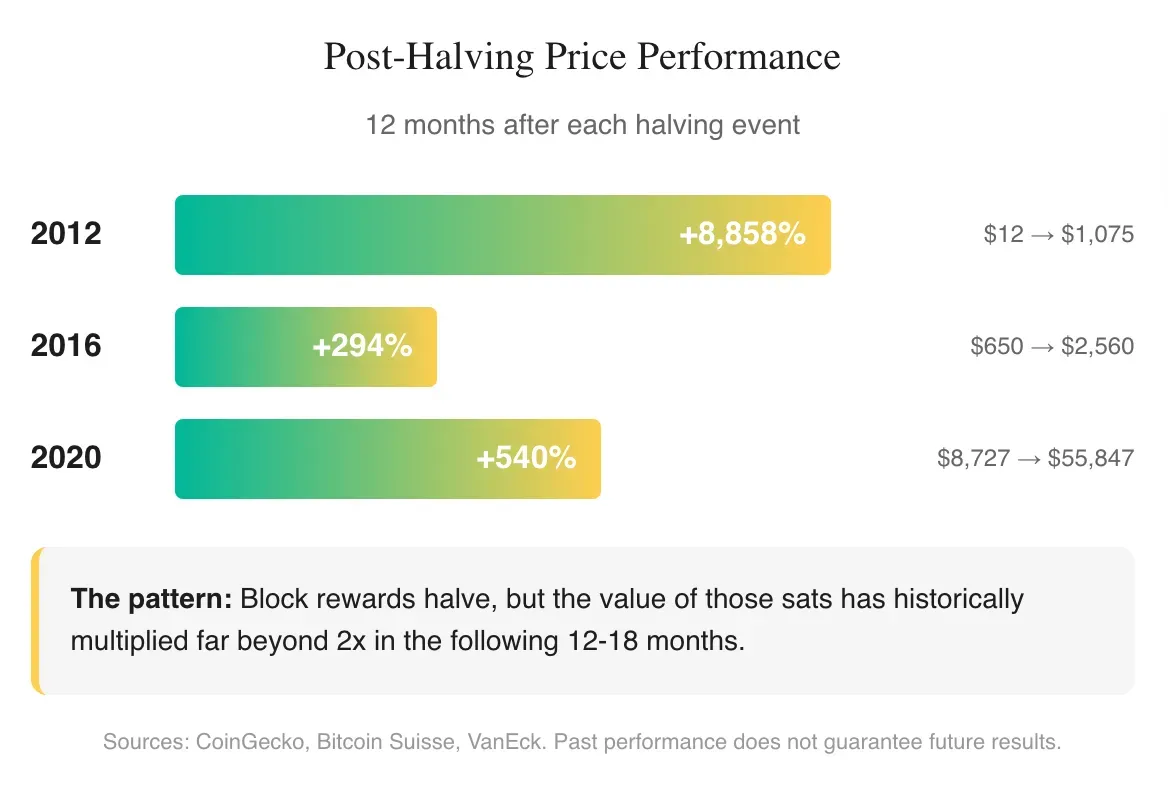
The block reward was halved, but the value of those sats? They didn’t just double, they multiplied by leaps and bounds.
Miners who stayed online through 2020’s halving earned 6.25 BTC per block instead of 12.5. But those 6.25 BTC became worth more than the 12.5 would have been at the old price.
The halving didn’t hurt them; it concentrated future value into fewer hands.
Not Everyone Gets to Play
Right now, the mining industry is experiencing what analysts call “capitulation.” Here’s what that looks like:
- Hashrate has fallen 15-20% from October 2025’s peak of 1.1 ZH/s
- Mining difficulty just dropped 11%, the steepest decline since China’s 2021 ban
- Hashprice collapsed from nearly $70/PH to roughly $35/PH
- Public miners reported production losses of up to 60% during recent Texas grid curtailments
Sources:CoinDesk,Hashrate Index,TheMinerMag
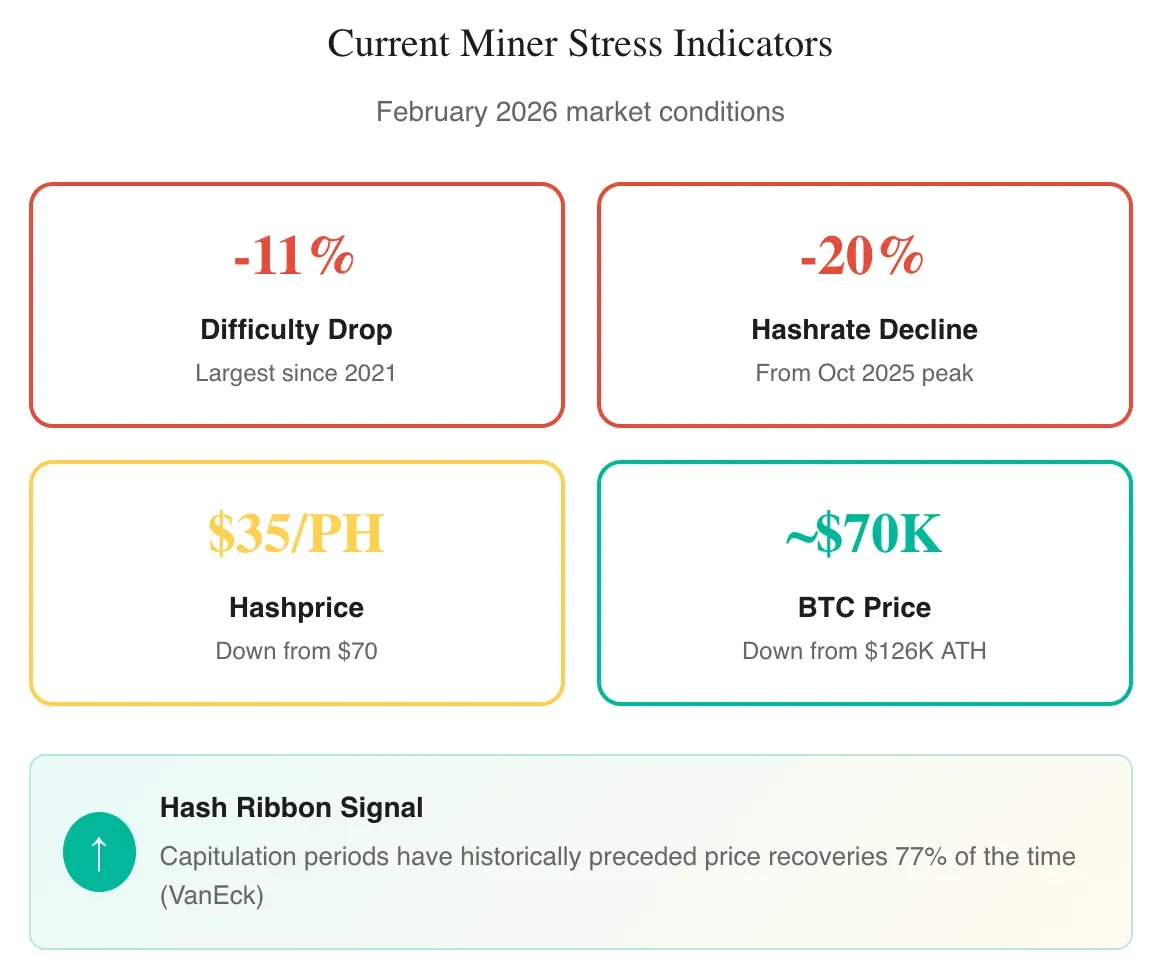
Translation: miners are shutting off machines, selling bitcoin to cover costs, and in some cases, pivoting away from mining entirely.
This is painful. But it’s also the point.
Bitcoin mining isn’t supposed to be easy. The protocol is designed to push out marginal operators and concentrate rewards among those who can survive. When difficulty drops 11%, that’s the network recalibrating. For miners who stay online, reduced competition means more sats per unit of hashpower.
The question isn’t whether mining is hard right now; it’s whether you have a seat at the table when conditions improve.
Most people can’t just “plug in” a miner:
- Industrial power rates ($0.04-$0.06/kWh) are inaccessible to residential customers
- Modern ASICs cost $4,000-$12,000 per unit
- Hosting, maintenance, and cooling require expertise and infrastructure
- Regulatory and permitting hurdles block most individual operators
Sazmining customers aren’t competing in their garages. They’re tapping into data centers in Paraguay and Norway, powered by carbon-free energy at rates most miners can only dream about.
When hashprice drops to $35, operators paying $0.12/kWh for residential power go underwater.
Operators running at $0.04-$0.06/kWh?
They’re still in the game.
Wild Sats: The Sovereignty Premium
Here’s something the “just buy on an exchange” crowd doesn’t talk about: not all bitcoin is created equal.
When you mine Bitcoin, it goes directly from the coinbase transaction to your wallet. These are “wild sats” with:
- No paper trail attached to your identity
- No exchange counterparty risk
- No dependency on banking infrastructure
- No transaction history that could be flagged or frozen
This isn’t paranoia.
It’s the original vision of Bitcoin: peer-to-peer electronic cash that doesn’t require permission.
Buying bitcoin on an exchange means providing your ID, linking your bank account, and trusting a third party to hold your coins (or allowing them to track your withdrawal). Bitcoin comes with a history. Your history.
Mining is different. The sats arrive in your wallet without asking anyone’s permission. You earned them by contributing hashpower to the network. They’re yours in the most fundamental sense.
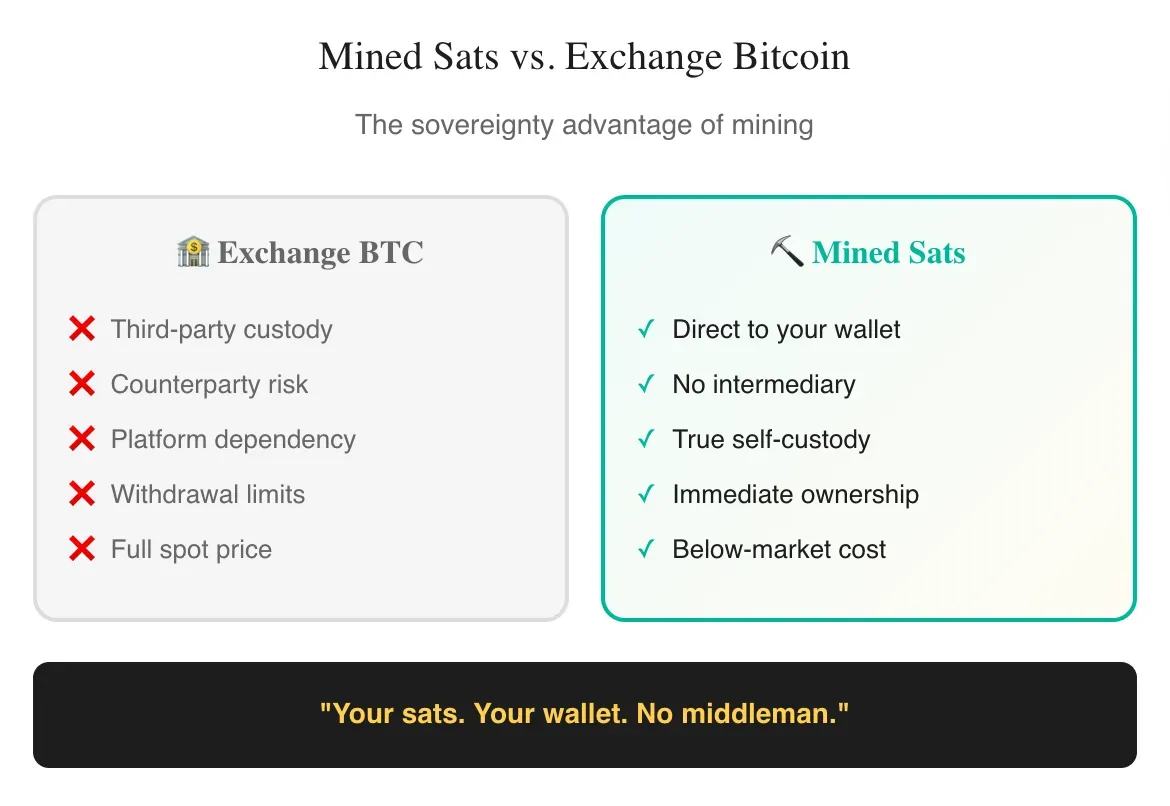
For Bitcoiners who take self-sovereignty seriously, this matters (a lot).
The Hidden Discount: Mining at Cost
Here’s the number that should get spot buyers’ attention.
According to recent analysis from CoinDesk, the global average cash cost to mine one bitcoin is around $70,000-$87,000. That’s the industry average, including operators who pay high electricity rates and run older hardware.
But optimized operations? The math looks very different.
At $0.04-$0.06/kWh with modern S21-class ASICs, efficient miners can produce bitcoin at an effective cost of $34,000-$51,000 per BTC.
Source:Compare Forex Brokers mining cost analysis
With bitcoin trading at around $70,000, that’s a 27-51% discount to spot price.
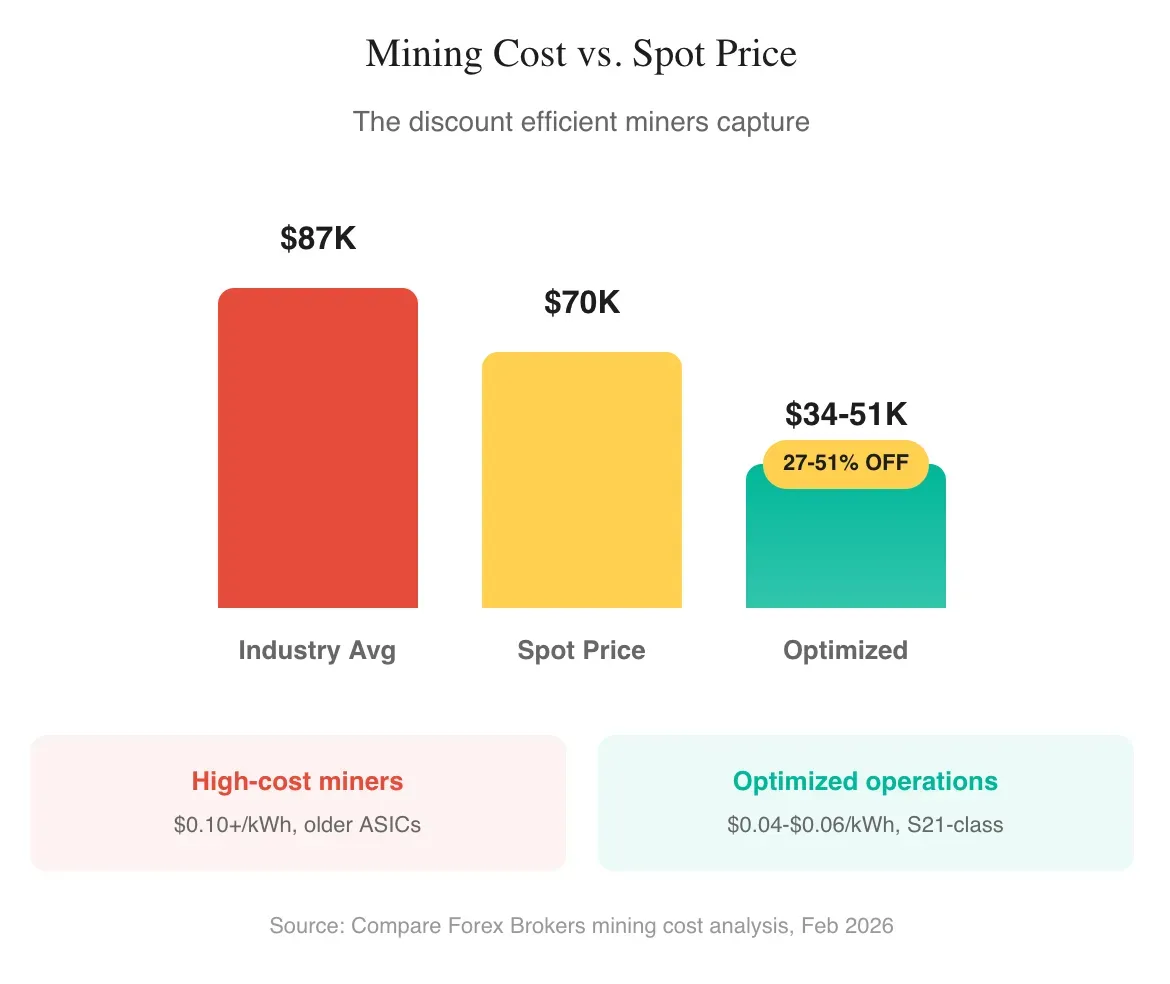
Think about that. While exchange buyers pay full market price for every sat, miners running efficient operations are accumulating bitcoin at a significant discount. Over time, that delta compounds.
This is the arbitrage that long-term miners understand. You’re not buying bitcoin. You’re manufacturing it at below-market cost.
The Capitulation Signal
Here’s what the current pain actually means.
When hashrate drops and difficulty declines, something called the “Hash Ribbon” indicator starts flashing. This metric tracks the 30-day and 60-day moving averages of hashrate. When miners capitulate, the short-term average falls below the long-term average.
Historically, Hash Ribbon capitulation signals have preceded significant price recoveries:
- FTX collapse (2022): Bitcoin bottomed near $15,000 during miner capitulation
- August 2024: Following Hash Ribbon capitulation, BTC bottomed at $49,000 before rallying to $100,000+
- November 2025: Hash Ribbon showed capitulation, BTC formed a low around $80,000
Sources:CoinDesk Hash Ribbon analysis,VanEck,CryptoSlate/Glassnode
The pattern is consistent: when inefficient miners exit and selling pressure exhausts itself, the price tends to stabilize and recover. The miners who survive the shakeout pick up market share as competitors drop out.
VanEck’s research found that periods of sustained miner stress have historically preceded renewed bitcoin price momentum. Negative 90-day hashrate growth, a sign of capitulation, predicted positive 180-day Bitcoin returns 77% of the time.
What This Means for Sazmining Customers
If you’re mining with Sazmining right now, here’s your position:
- You’re operating in low-cost jurisdictions (Paraguay, Norway) with power rates that keep you profitable when others go underwater
- Your sats go directly to your wallet with no exchange, no counterparty, and no KYC attached to your mining rewards
- You’re accumulating during capitulation when competition is declining, and difficulty is adjusting in your favor
- You’re manufacturing bitcoin at a discount to what spot buyers pay on exchanges
- You have a seat at the table when conditions improve, price recovers, and the cycle turns
The halving didn’t end bitcoin mining. It raised the bar. And if you cleared it, you’re now competing in a smaller, more concentrated field for the same 3.125 BTC per block.
The Long Game
Mining Bitcoin isn’t a get-rich-quick scheme. It’s a long-term accumulation strategy for people who understand that:
- Scarcity increases over time as halvings continue
- Price has historically followed supply reduction with a significant lag
- Surviving the pain is the price of admission to the gains that follow
- Direct ownership beats exchange exposure for serious long-term holders
The miners who were running in 2020 and held through the halving saw their bitcoin appreciate 540% over the following 12 months. The ones who panicked and shut down missed it.
Right now, bitcoin is trading at $70,000. Hashprice is at $35. Difficulty just dropped 11%. The weak hands are exiting.
If you’re still here, still mining, still accumulating sats at a discount while sending them directly to your wallet?
That’s not surviving the halving. That’s using it.
Key Takeaways
- The halving doesn’t halve your wealth. Historical data shows price appreciation far exceeds the 50% reward cut over 12-18 month periods.
- Not everyone can mine. Industrial power rates, hardware costs, and infrastructure requirements create barriers that exclude most participants.
- Wild sats carry a sovereignty premium. Mining delivers KYC-free bitcoin directly to your wallet with no exchange dependency.
- Efficient miners operate at a discount. Low-cost operations can produce bitcoin at 27-51% below the spot price.
- Capitulation signals recovery. Hash Ribbon data and historical patterns suggest current miner stress often precedes renewed price momentum.