The Call Your Accountant Makes Every October
Somewhere around October, your accountant calls with a version of the same problem. You’ve had a good year. Profit is up. And if you don’t do something with it before December 31, a significant portion of it goes to the government.
You know the options. Equipment. Vehicles. Prepaid expenses. Business owners who have been around long enough know that the IRS has effectively built a mechanism for redirecting taxable income into productive assets, and that the smart move is to use it rather than write a check.
Most of them buy a truck. Some buy a G-Wagon, because vehicles over 6,000 pounds qualify for the full Section 179 deduction and depreciate to nothing over the following years.
There’s another option most accountants have never modeled. It produces something the truck doesn’t.
What Bitcoin Mining Actually Is
Bitcoin mining is not what most people picture. It is not a speculative trade. It is not a crypto casino. And for a business owner, it is not something you do instead of a financial strategy. It is the financial strategy.
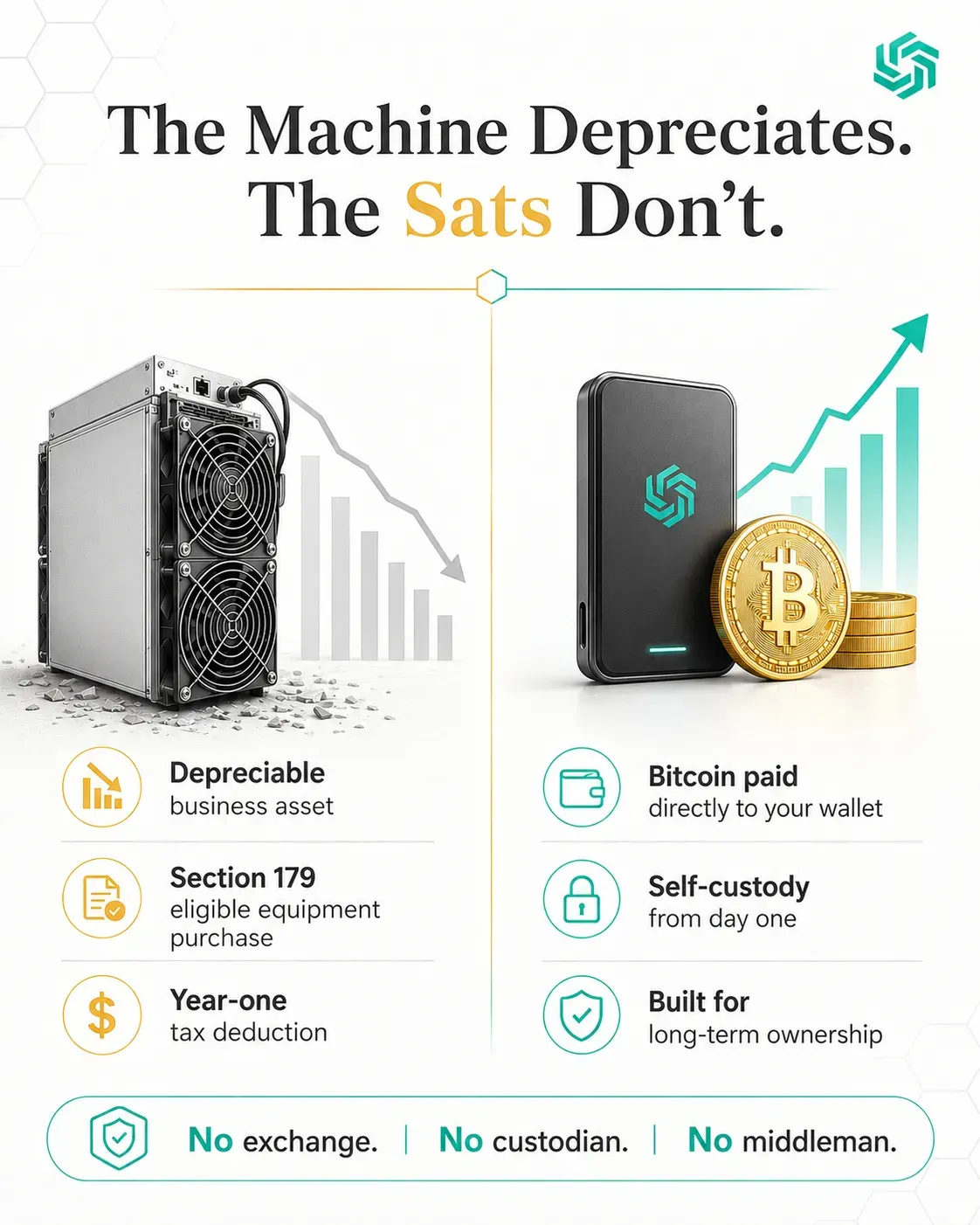
Here is the mechanical reality: a mining rig is a piece of computing hardware. It is a depreciable business asset under Section 179, the same as any other equipment purchase. You buy it through your business entity, you deduct it in the year of purchase, and it goes to work.
What it produces is Bitcoin, paid directly to a wallet you control. Not to an exchange. Not to a custodian. Directly to cold storage, with no middleman between the output and your ownership.
For someone who already thinks in cash-flowing assets, the mental model is straightforward. A rental property produces rent. A dividend portfolio produces dividends. A mining fleet produces sats, continuously, directly to your wallet, for as long as the machines are running.
The difference between this and buying Bitcoin on an exchange is custody, provenance, and entry cost. With exchange-purchased Bitcoin, you pay full price with after-tax dollars and hand it to a third party to hold. With a mining fleet purchased through your business, you reduce the entry cost by your marginal tax rate, take delivery directly, and own it outright from the first sat.
What Goes In, What Comes Out
Here is a real-world example drawn from an active hosted fleet.
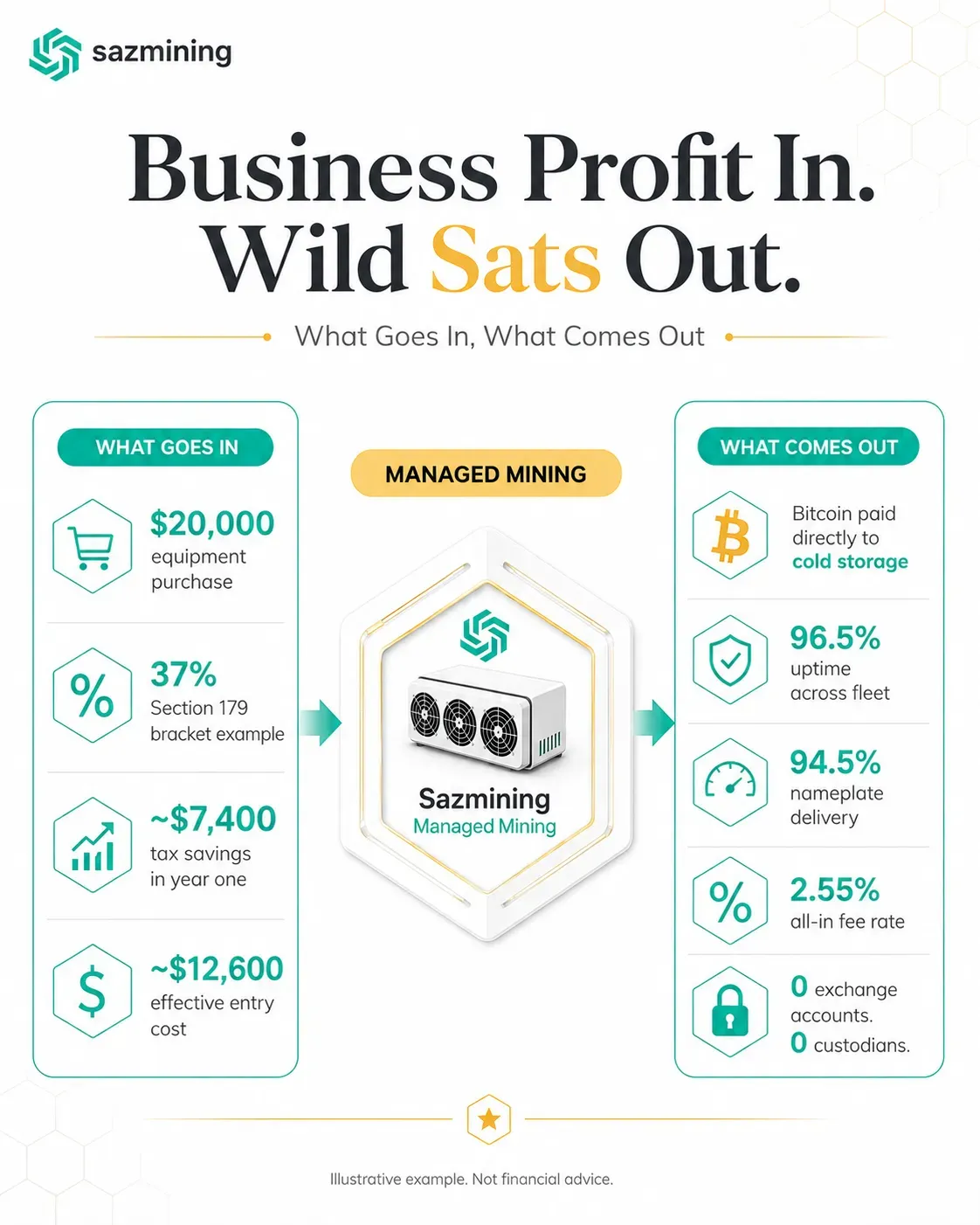
A business owner deploys 23 machines across three sites, with a combined nameplate hashrate of 6.07 PH/s. Over 16 months of continuous operation, the fleet delivers 96.5% uptime and 94.5% nameplate delivery.
The result: 0.892 BTC paid directly to their wallet after all pool fees and network costs.
Total all-in fee load across the full period: 2.55%.
To put that in terms of a smaller starting position: a business owner who starts with 5 machines at roughly $4,000 per unit is looking at a $20,000 equipment purchase. At a 37% federal marginal rate, Section 179 brings the effective entry cost down to approximately $12,600 after the year-one deduction. The fleet runs, the sats accumulate, and the Bitcoin goes directly to cold storage.
The machine depreciates. The sats don’t.
How to Grow Your Stack Over Time
The most durable approach to growing a mining position is not chasing the newest hardware. It is consistency and compounding.
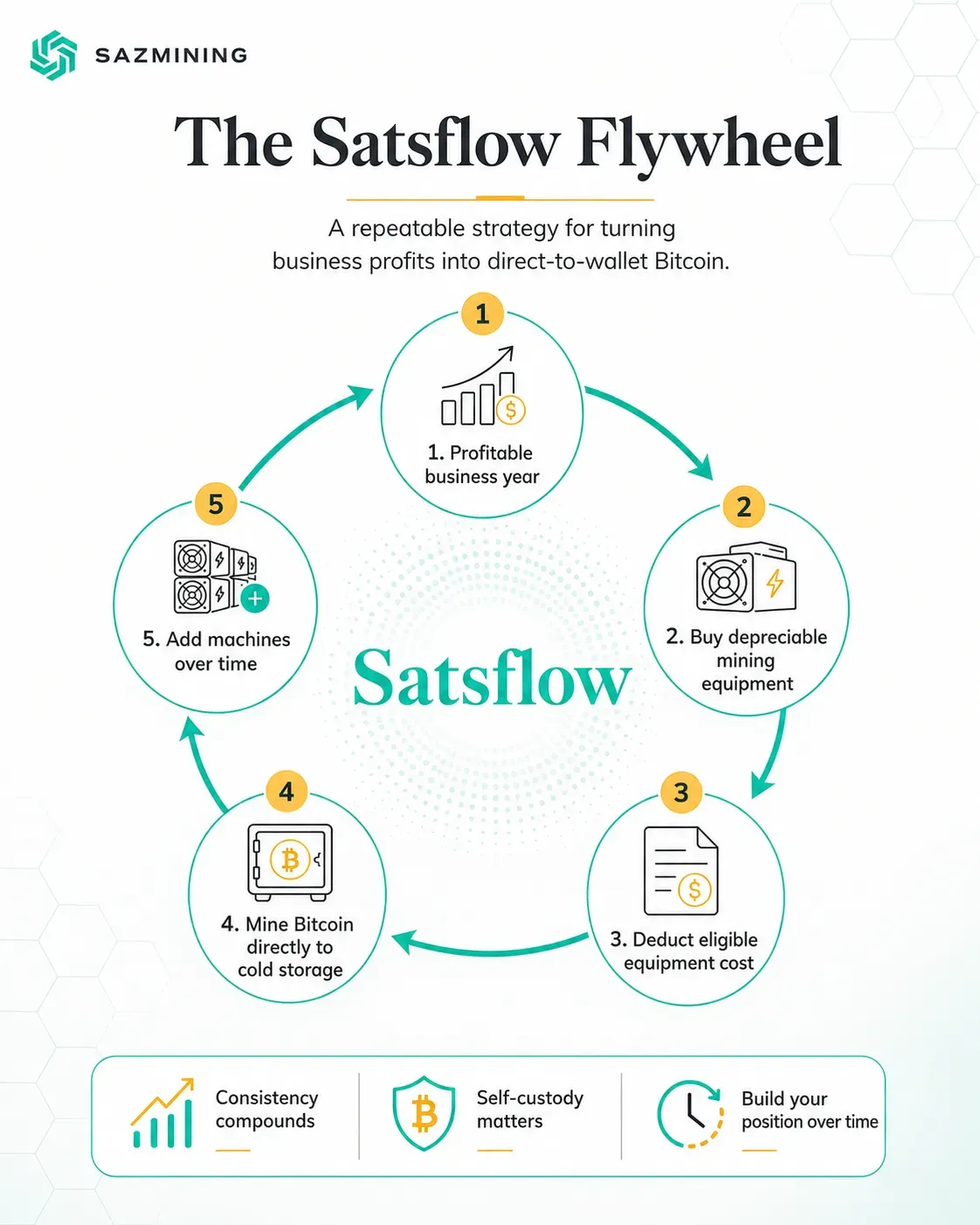
Start with what you can depreciate
The strongest entry point for a business owner is a year-end equipment purchase that serves a dual purpose: reduces taxable income immediately and begins producing Bitcoin. This is not a one-time move. Business owners who treat it as an annual discipline, adding to their fleet each year during the tax planning window, build a position that grows in both hashrate and accumulated sats over time.
Hold in self-custody from day one
Every sat that goes to an exchange is a sat that is no longer in your direct control. The compounding effect of self-custody is not financial, it is structural. Bitcoin held in a wallet you control cannot be frozen, seized by a platform’s insolvency, or subject to a third party’s policy changes. Set up cold storage before your first payout arrives.
Choose your pool carefully
Pool fees and payout structures vary. Some pools charge lower fees with daily payout options. Others charge slightly more but zero transaction fees, with long-run sat yields that tend to run approximately 5% higher. The difference compounds meaningfully over a multi-year position.
Reinvest at scale
As the fleet produces, the accumulated Bitcoin can eventually be used as collateral for business financing without triggering a taxable event. This is a more sophisticated strategy for later stages, but worth understanding early: the sats you mine today have leverage potential beyond their spot value.
The Part Nobody Talks About
There is a version of this conversation that is purely financial. Returns, yields, depreciation schedules. That version is important, and your accountant should review all of it before you make any decisions.
But there is another version worth sitting with for a moment.
Because of how Bitcoin works at a technical level, every sat that is mined and held in self-custody carries a traceable origin forever. Your grandchildren will be able to look at a wallet and see exactly when those sats were mined, where they came from, and how they moved. That is not possible with Bitcoin purchased on an exchange, where the origin is the exchange’s internal ledger and nothing more.
The machine is a business asset. The Bitcoin it produces is something else entirely. It is a decision they will be able to point to.
Bitcoin mining involves operational and market risks. Section 179 eligibility depends on individual business circumstances. This article is not tax or financial advice. Consult a qualified CPA or financial advisor before making any equipment or investment decisions.
Interested in learning more?
Talk to a Bitcoin Strategy Advisor → sazmining.com/free-consultation