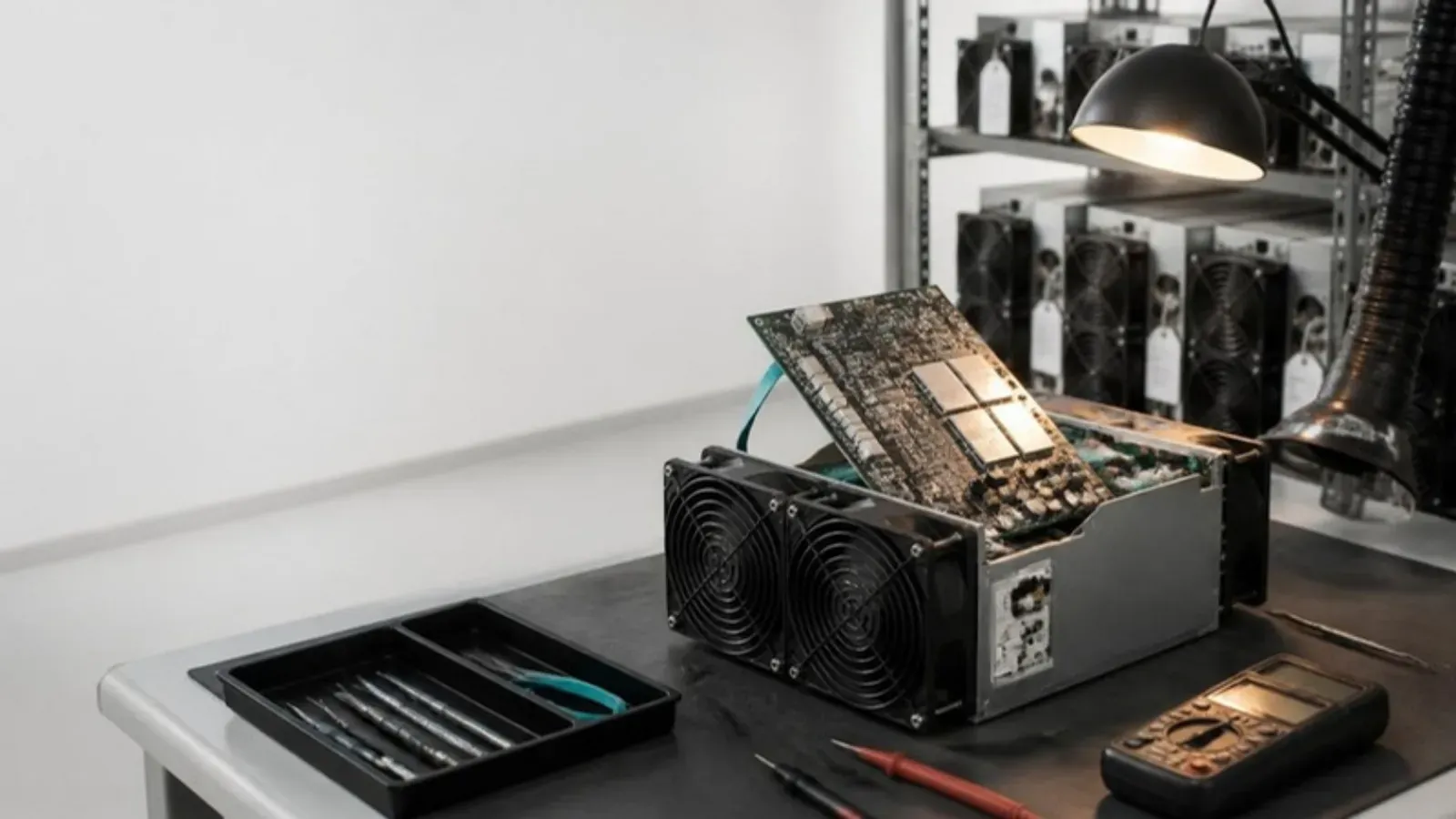
When one of your miners stops hashing, our job is to get it back online as fast as possible. Or, when it can’t be, to tell you plainly.
You can’t walk into the facility and check on your machine yourself. So here’s exactly what happens, from the moment a miner goes quiet to the moment it’s hashing to your account again.
Some of these steps typically take hours. Others take days or weeks. Here’s how each one works, and why. The times below are estimates based on how repairs usually go, not guarantees.
1. We check every machine about once a day
We aim to audit the hashrate of every machine in our fleet at least once every 24 hours. So a miner that stops hashing is usually caught within a day.
Any machine reporting 0 TH/s is flagged and moves straight to the next step.
2. We try several remote reboots
A flagged machine first gets several remote reboots. A restart is the quickest fix there is, and it doesn’t need anyone on site.
If a reboot brings the miner back, it goes straight back to hashing for you.
3. Our on-site team does a long power cycle
If the machine is offline, or the reboots don’t work, our on-site team takes over. They do a long power cycle: a manual reboot, done at the machine itself.
The power cycle itself is quick. Getting a technician to the machine typically takes up to 24 hours.
4. If that fails, the miner is pulled for repair
If the manual reboot doesn’t bring it back, the on-site team pulls the miner from its slot and gets it ready to go for repair.

5. Repair depends on where your miner runs
Paraguay: repaired locally, in batches of 30
Our Paraguay repair team has grown to several technicians. They work on up to 30 machines at a time. A miner that arrives mid-batch joins the next batch of 30.
The team has its own process for diagnosing, sorting and fixing machines. No two repairs are alike. Some faults are quick to fix. Others take far longer.
Texas, South Dakota and Norway: shipped to a repair facility
Miners at these sites are physically shipped to a repair facility. There’s no batch to wait for, since one machine can go on its own. Shipping does add time.
Here, our target is to have miners back in around 4 weeks.
6. Every repaired machine is tested, typically for about 7 days
A repaired miner isn’t sent straight back. First it typically runs through about 7 days of testing, to see whether any new issues show up.
It’s not unusual to find something in this window. When we do, the machine goes back for more repair. We’d rather catch a problem here than after it’s back on your account.
7. Sometimes a repair isn’t possible
Not every machine can be fixed. When a repair doesn’t work, the machine is retired.
Why not just use spare parts?
It’s a fair question, and the answer is supply. Bitmain makes most of the Bitcoin mining hardware in use today, and it earns a higher margin selling complete machines than spare parts. So replacement parts are hard to come by, and that limits what any repair team can do.
8. Back in its slot and hashing
Once a machine passes both repair and testing, it goes back into its slot and resumes hashing to your account.
How long does it all take?
It depends on how far down this list your machine goes, and where it runs. Detection usually takes up to 24 hours, since we aim to audit at least daily. A remote reboot is the fastest way back. A long power cycle typically adds up to 24 hours, depending on when a technician gets to the machine.
Repair takes longer. In Paraguay, we estimate 4 weeks or more from the moment a miner is pulled.
Then comes about a week of testing, plus another round of repair if testing turns up a new issue.
In Texas, South Dakota and Norway, where miners are shipped to a repair facility, our target is to have them back in around 4 weeks.
| Step | Estimated time |
|---|---|
| Detection (daily audit) | Usually within 24 hours |
| Remote reboots | The fastest fix |
| Long power cycle (on site) | Typically up to 24 hours, depending on technician availability |
| Repair, Paraguay | Estimated 4 weeks or more |
| Repair, Texas, South Dakota, Norway | Target of around 4 weeks |
| Testing | About 7 days, plus another repair round if a new issue shows up |
These are estimates, not deadlines. Every repair is different, and some take longer.
What you pay while your miner is in repair
No service fees. If your miner isn’t using electricity, it isn’t counted on your invoice.
Routine maintenance is part of your Service Plan: cleaning, power cycling, and replacing fans, power supplies, control boards and hash boards as needed. Under your Service Agreement, if your replacement costs go over $150 in a year, we may pass the excess on to you. Any extra repair work you ask us for is billed at $75 per hour.
Machines break. The useful part is knowing what happens next, and roughly when. To see how time offline fits the bigger picture, our mining calculator lets you run the numbers.
If your miner is in repair and you’d like to know where it stands, email us at support@sazmining.com. We’re always happy to walk you through which step it’s at and what comes next.
Questions? Talk to your BSA.