By Kent Halliburton, CEO & Co-Founder, Sazmining
For the first sixteen years of Bitcoin’s existence, hashrate only went one direction. Price crashed, exchanges blew up, China banned mining outright, and the network shrugged all of it off and kept growing. Hashrate going up was about as close to a law of physics as this industry had.
Well, that law just broke. Hashrate peaked near 1.1 zettahash late last year and has fallen more than 20% since. We are living through the first hashrate bear market in Bitcoin’s history.
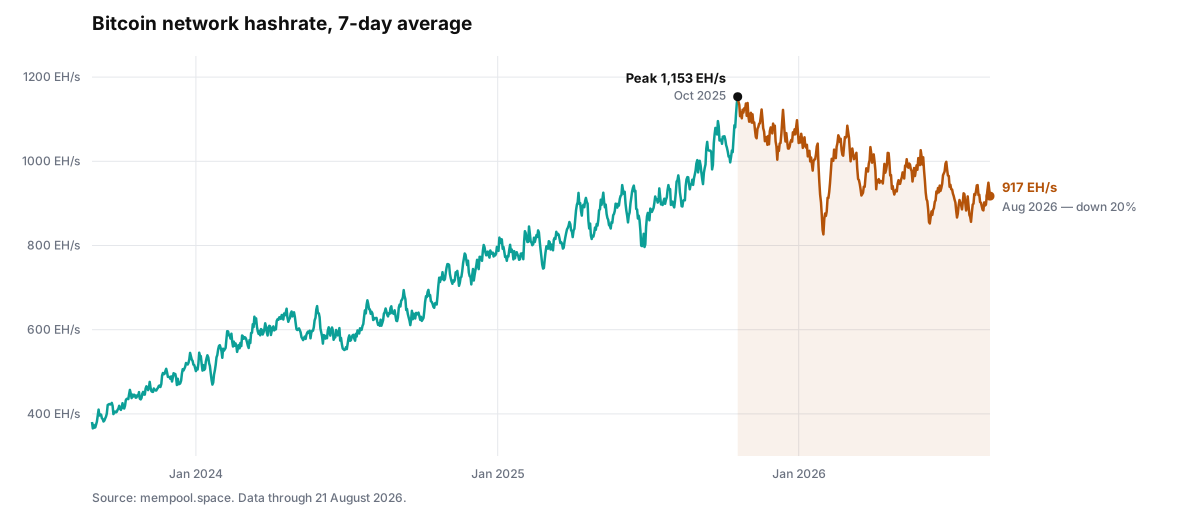
Most people look at that and conclude mining is a bad business to get into right now. I’ve come to the opposite conclusion. I think we’re entering the best window to start mining we’ve ever seen, and maybe ever will see. I’m calling it the Golden Pocket, and I want to walk you through why.
Why hashrate is falling
There’s a double whammy at work here.
The first part is straightforward margin compression. Bitcoin is trading about half off its highs. Hashprice, the daily revenue a miner earns per unit of computing power, has roughly halved over the past year, from around $63 per petahash to about $32. When revenue gets cut in half, the least efficient machines turn off. Nothing new there. We’ve seen that movie in every cycle.
The second part is new, and it’s the one that matters. For the first time in Bitcoin’s history, mining has real competition for its scarcest resource: powered land. The AI buildout has come for the same energized sites that miners spent a decade developing, and the publicly traded miners are taking the deal. They’ve signed over $70 billion in AI and high-performance computing contracts. By some estimates, AI will make up 70% of public miner revenue by the end of this year.
And here’s the thing about those AI pivots: there’s no coming back from them. AI infrastructure runs $8 to $15 million per megawatt to build. Bitcoin mining runs about $1 million. Once a company pours ten times the capital into a site and signs a five-year contract with a hyperscaler, that megawatt is gone. It is never coming back to Bitcoin, no matter how attractive mining gets. I think we may look back at 2026 as a split in the timeline for Bitcoin’s hashrate market. A big chunk of industrial capacity just left the field, and it locked the door on the way out.
The part nobody is talking about: the manufacturers
All that downward pressure has second-order consequences, and this is where it gets really interesting to me. The hardware manufacturers are now competing against themselves. On two levels.
Level one is the secondary market. As the public companies pivot to AI, they’re liquidating perfectly good mining rigs. IREN alone put roughly 5,800 Antminer S21 Pros up for sale and wrote down $140 million on displaced mining hardware. These are machines with two-plus years of useful life left, hitting the market at around a third the price of new equipment. Every one of those rigs competes directly against Bitmain’s new inventory. So Bitmain has had to squeeze its own margins to close the gap, with some machines now quoted as low as $3 to $4 per terahash. Pricing like that would have been called a fire sale a cycle ago.
Level two is the one that really tells you something. With all this unsold inventory sitting around, the manufacturers have gotten aggressive in the hosting market. They’re out striking deals with hosts to plug in their own machines and mine with them. Sit with that for a second. The company that builds the machines is now mining against the very customers it wants to sell those machines to, and competing with them for rack space while it’s at it. If you’re an existing miner, you’re no longer just competing with other miners. You’re competing with your own supplier.
And there’s a third pressure squeezing them. The chips inside these machines come off the same advanced TSMC production lines as the AI chips, and AI demand has pushed wafer prices up. TSMC is raising prices on its advanced nodes again this year, with more increases already penciled in for next. So the manufacturers are watching their input costs rise at the exact moment demand for their product is collapsing.
Now, I’ll be straight with you: I have no inside data on Bitmain’s production lines. But put yourself in their seat. You’re sitting on unsold inventory, discounting against your own products in the secondary market, plugging your excess machines into hosting deals, and paying more for every wafer. Do you keep production running full tilt? Of course not. I’m convinced production capacity has been cut substantially, because it’s the only rational move available to them.
What it all means: the Golden Pocket
So play the tape forward.
At some point, Bitcoin’s price recovers. It always has. When it does, mining economics flip fast, and demand for machines comes roaring back. This time, that demand will come largely from regular people, because the public companies have taken themselves off the field. And here’s the difference from every previous cycle: the supply side won’t be able to answer.
The public miners can’t pivot back. They’re locked into multi-year AI contracts on infrastructure that cost ten times mining capex. The manufacturers can’t ramp back up quickly, because semiconductor supply chains don’t turn on a dime, and now they’d be bidding for wafer capacity against AI companies with effectively unlimited budgets. And the flood of cheap secondary-market rigs is a one-time liquidation. Once those machines find homes, they’re gone.
Put your own numbers on this, but my estimate is it takes 12 to 18 months for the manufacturers to ramp production back up once demand returns. That window, where price is rising and hashrate physically can’t keep up, is the Golden Pocket. Everybody who is plugged in when it opens gets to ride expanding margins with nobody able to compete those profits away. In a normal cycle, new machines flood in and arbitrage that away within months. In this cycle, the arbitrage mechanism itself is broken. I don’t think we’ve ever seen anything like it on the Bitcoin network.
An honest word about right now
I won’t pretend today’s numbers look pretty. At current hashprice, paper returns on mining are as thin as they’ve been in years. If you evaluate mining purely on this month’s spreadsheet, you’ll pass. So will almost everyone else. That’s exactly why the opportunity exists.
There are what-ifs in this thesis, and I’ve tried to be upfront about which parts are my inference. But the core of it isn’t a what-if. The first hashrate decline in Bitcoin’s history is a fact. The manufacturers cannibalizing themselves is happening in plain sight. The AI capital migration is signed in ink. The only forecast you have to make is the one most of us already believe: that Bitcoin’s price eventually goes up.
If it does, the machines plugged in during this pocket will be mining into expanding margins while the rest of the market stands in line for hardware that doesn’t exist yet. That’s Bitcoin at the cost of production, paid straight to your wallet. Wild sats, mined rather than bought.
This is what we built Sazmining for. We’re the Airbnb of Bitcoin mining: you own the machine, we run it on renewable energy, and the Bitcoin it mines goes directly to your wallet. No exchanges, no custodians, no IOUs. It’s a wonderfully advantageous time to get started.
Who knows when we get another one.
Want to see what a machine plugged in today actually produces?
Talk to our team and we’ll walk you through the real numbers: what a rig costs, what it earns at today’s hashprice, and what it looks like if the Golden Pocket opens the way I think it will.