
If you've mined on other pools before, you've probably seen a daily, weekly, or monthly payout land in your account without much explanation of how it was calculated. Most pools keep that part opaque.
OCEAN doesn't work that way, and neither does the system it uses to calculate your cut.
Here's how OCEAN's payout model works, what TIDES is, and why it's different from what most other pools use.
How Most Mining Pools Pay Out
Traditional mining pools act as custodians. Your hardware mines, the pool collects the rewards, runs its own formula, and sends you a payment on its schedule. You don't touch the Bitcoin until the pool decides to send it.
Most pools use one of two payout models:
FPPS (Full Pay Per Share): You're paid a fixed rate for each share submitted, regardless of whether the pool actually finds a block. The pool absorbs the variance. In exchange, transaction fees are estimated and averaged across all miners. During high-fee periods, the pool captures the difference between the estimated rate and the actual fees earned.
PPLNS (Pay Per Last N Shares): Your payout is based on your contribution within a recent window of shares. In most implementations, shares are grouped into shifts that reduce resolution, and the window is short. Downtime can cause you to miss an entire round.
Both models require the pool to hold your funds at some point in the process.
How OCEAN Is Different
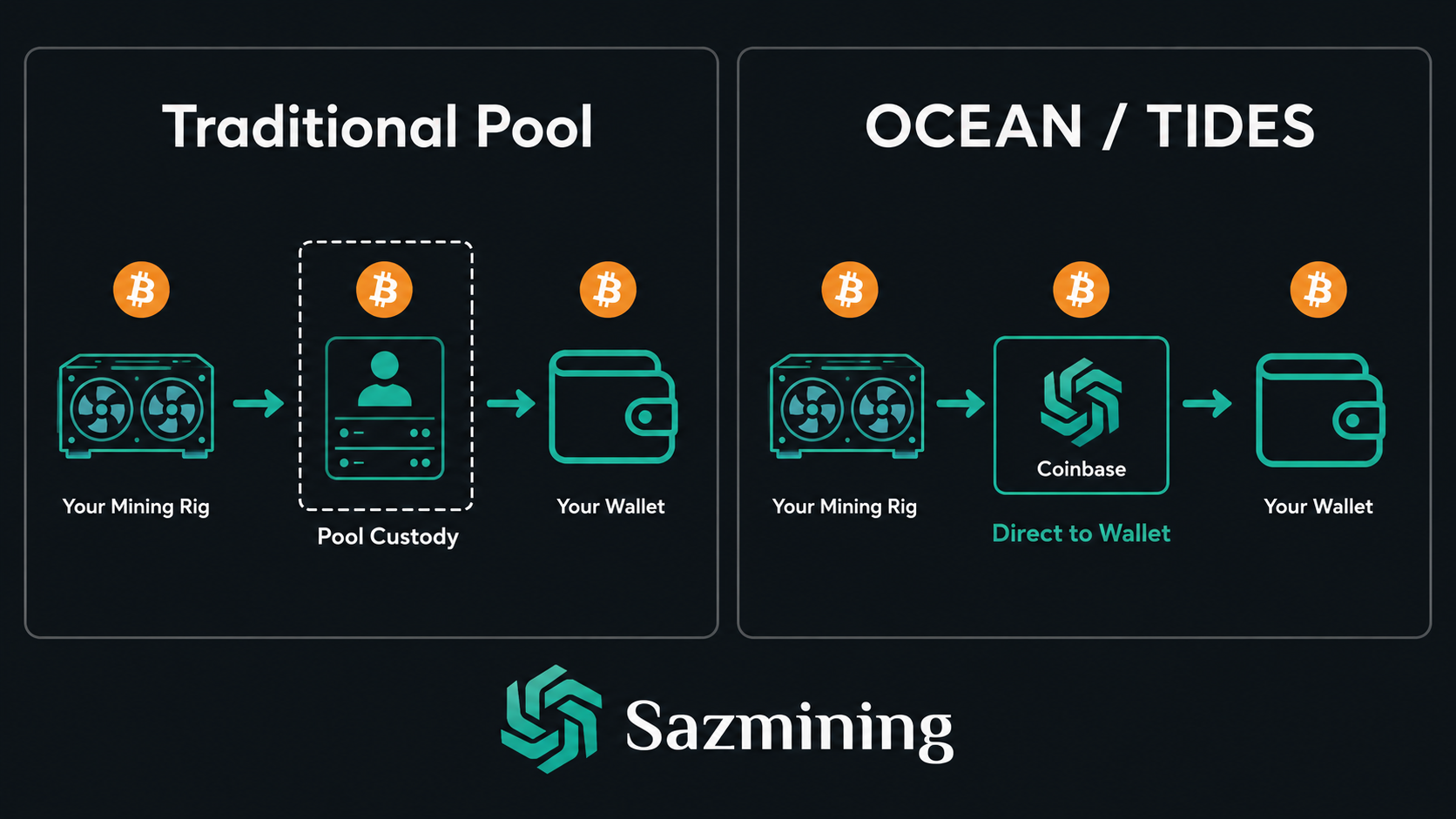
OCEAN was built around a direct principle: your Bitcoin shouldn't pass through anyone else's hands.
When OCEAN finds a block, the payout goes directly from the coinbase transaction, which is the first transaction in every block that creates new Bitcoin, to your wallet address.
OCEAN never holds your funds. There's no buffer, intermediary, or trust required.
Because payouts are pre-calculated and embedded in the coinbase transaction before a block is even found, there's no scenario where OCEAN could withhold or adjust your earnings after the fact. The Bitcoin protocol itself handles delivery.
For that to work, OCEAN needed a system that could calculate exact reward splits in advance. That system is TIDES.
What Is TIDES?
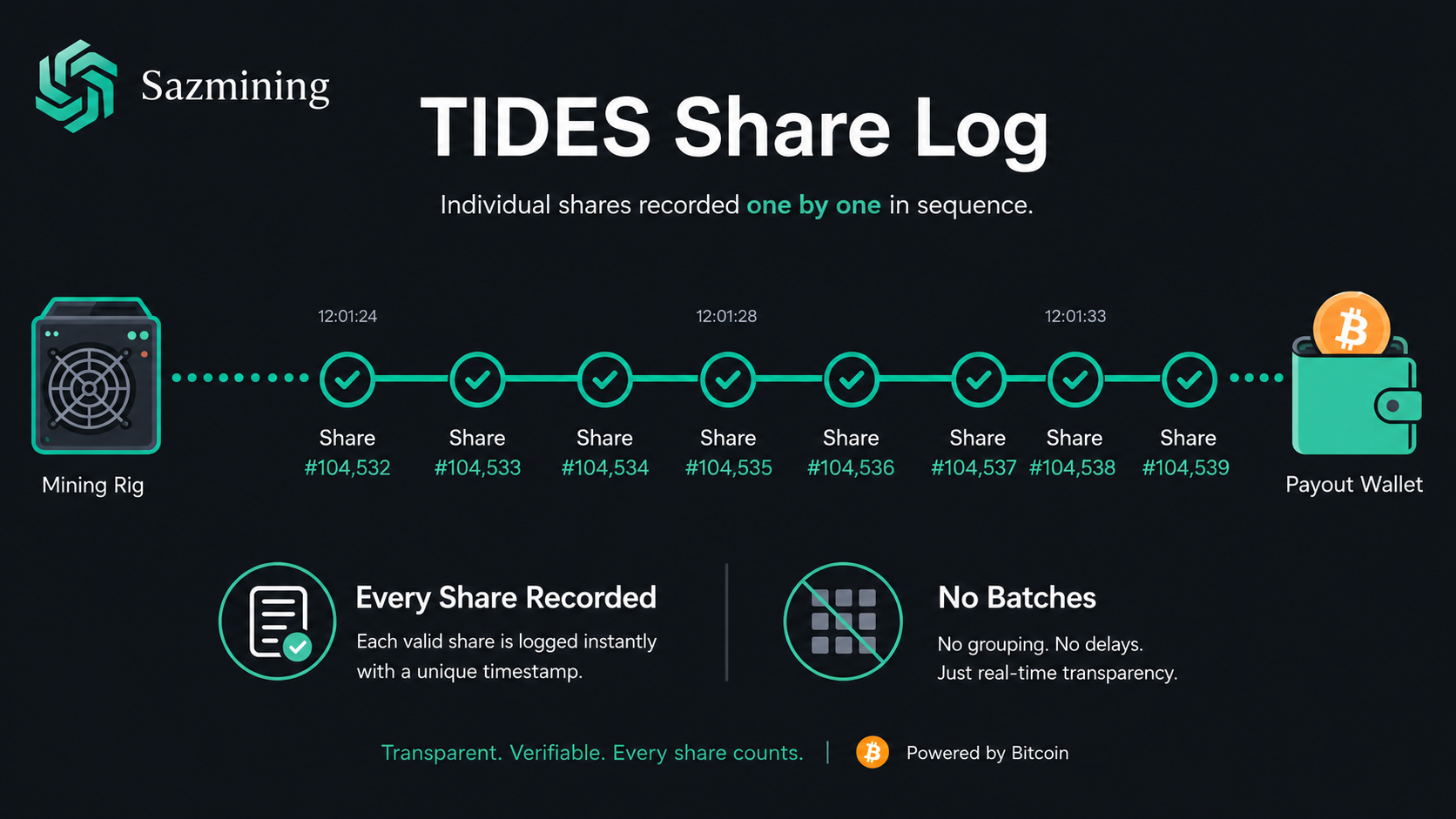
TIDES stands for Transparent Index of Distinct Extended Shares.
Every share your rigs submit to OCEAN is recorded individually in a continuous log. Not in batches, not in shifts, not averaged with other shares. Each proof is stored distinctly, in order, tied to the exact amount of work it represents. This is what 'Distinct' in the name refers to: no resolution is lost.
When OCEAN finds a block, the reward is split across the most recent 8x network difficulty worth of shares in that log. That's the TIDES window. Your percentage of the window is your percentage of the block reward, including all transaction fees.
Your payout = your shares in the window ÷ total shares in the window × block reward.
That math is fully auditable. You can verify it yourself, block by block.
Why the Window Size Matters
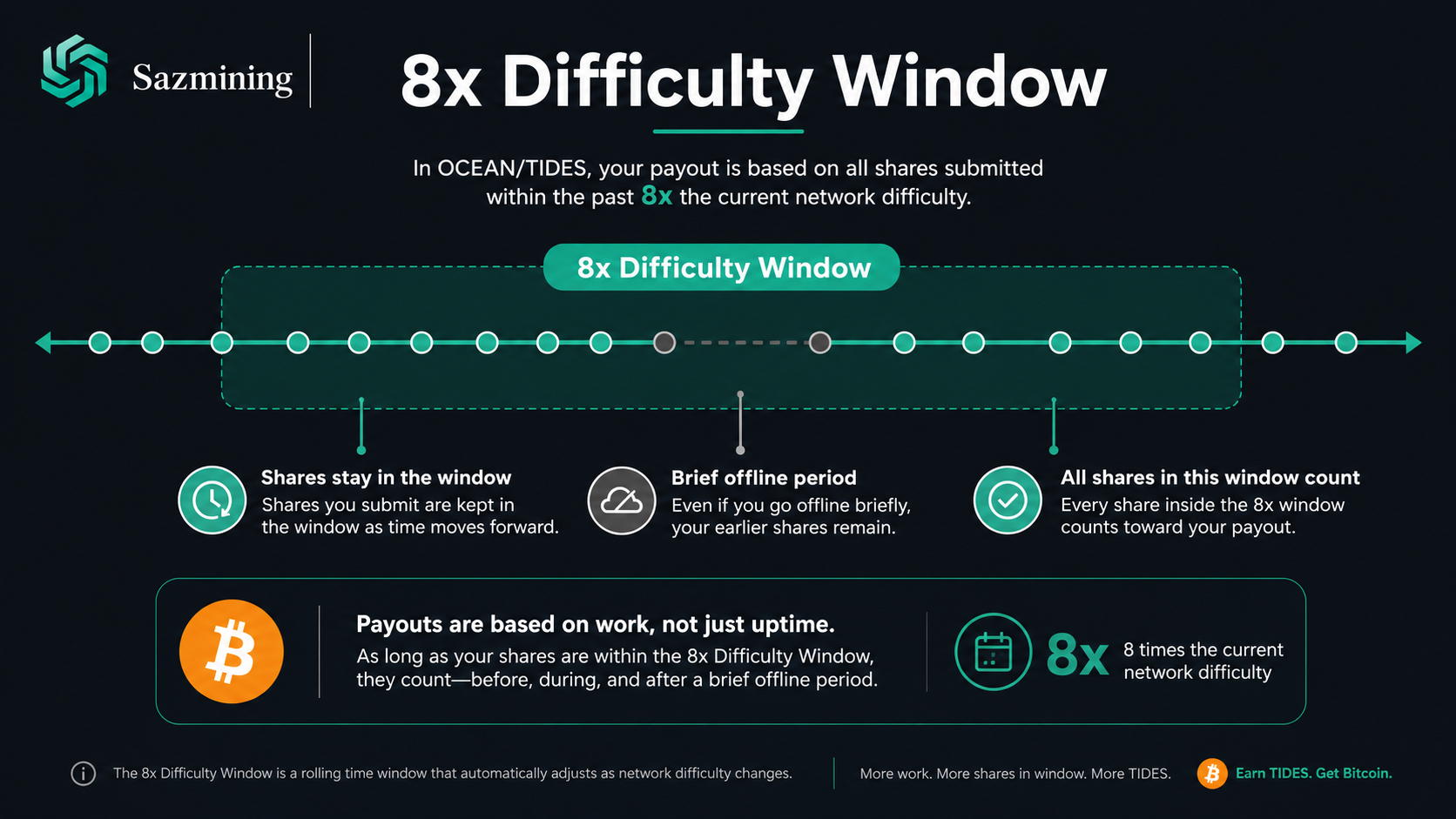
The 8x difficulty window is large by design. It gives every share you submit a 99.9665% chance of being rewarded at least once and, on average, eight times.
Traditional PPLNS windows are much smaller, which means higher variance and a real chance of missing rewards if you're offline when a block is found.
Because the TIDES window spans many hours of accumulated work, brief offline periods barely affect your earnings. Your existing shares stay in the window and keep earning as blocks are found. Once you're back online, you rebuild your share density and return to your normal rate. Shares are never removed from the log.
New miners on OCEAN see a short ramp-up period while their shares fill the full window. After that, payouts are consistent.
TIDES vs. FPPS: The Real Comparison
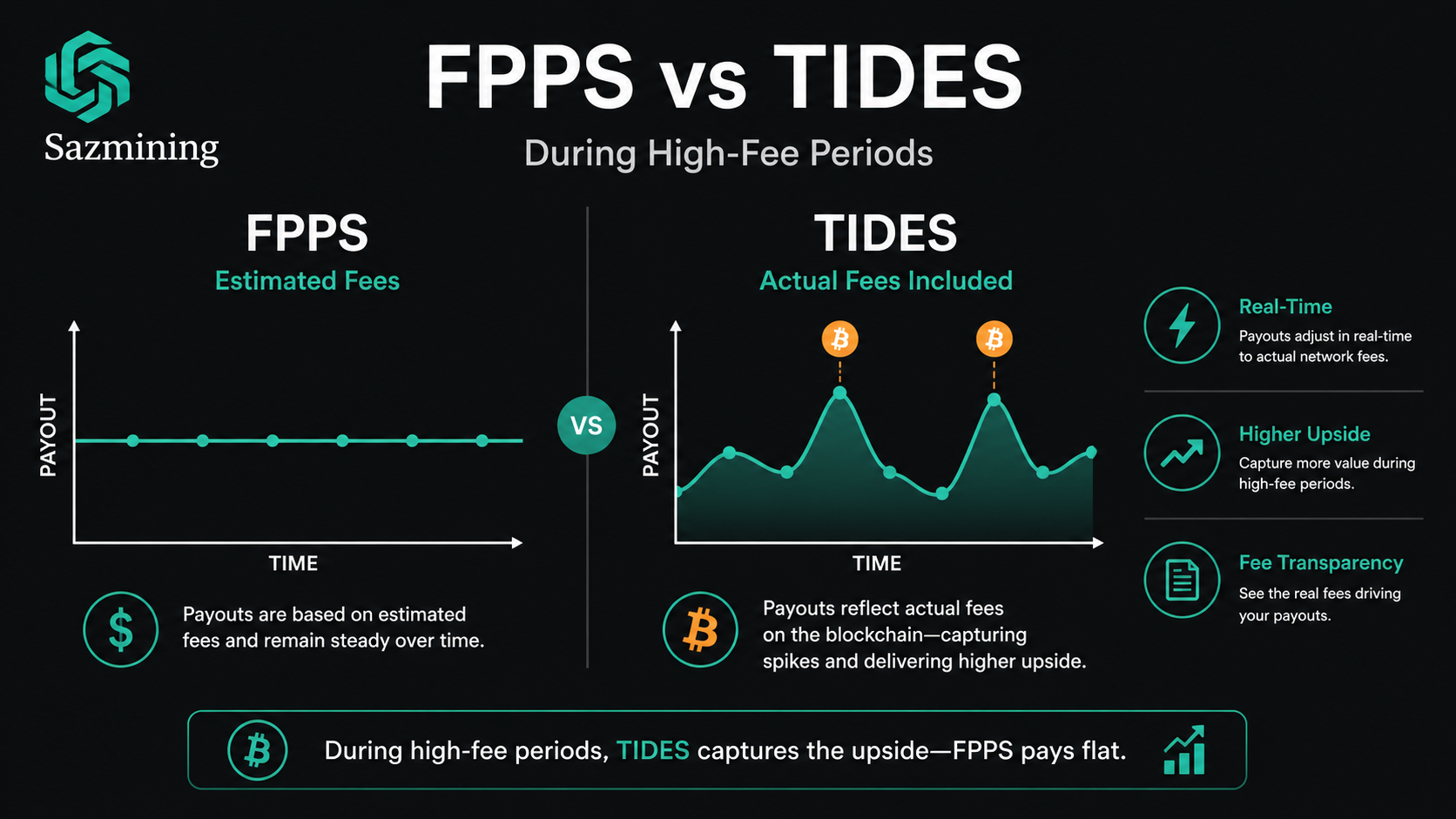
With FPPS, you're getting a smoothed estimate. Variance is predictable, but transaction fees are averaged and the pool captures the upside during fee spikes.
With TIDES, you get your exact pro-rata share of the actual block reward, transaction fees included. No estimates, no smoothing. If fees are high when a block is found, you earn directly from that.
The trade-off is that TIDES only pays when blocks are actually found. There's no pool buffer guaranteeing payouts on a daily schedule.
For miners with consistent uptime, TIDES is the more transparent option and can outperform FPPS during high-fee periods since you're capturing actual fees rather than averages.
How Sazmining Uses OCEAN
Sazmining handles the infrastructure side so you don't have to. That includes running full Bitcoin nodes, using DATUM to build block templates, and selecting transactions using Bitcoin Knots' default policies. Your rigs connect and mine without any additional configuration.
Your payouts go directly from the coinbase transaction to the wallet address you set up with your BSA. That's non-custodial in practice: no pool holding your sats between blocks, no intermediary, no counterparty risk.
If you have questions about how your setup interacts with OCEAN payouts, reach out to your Bitcoin Strategy Advisor or email support@sazmining.com.