
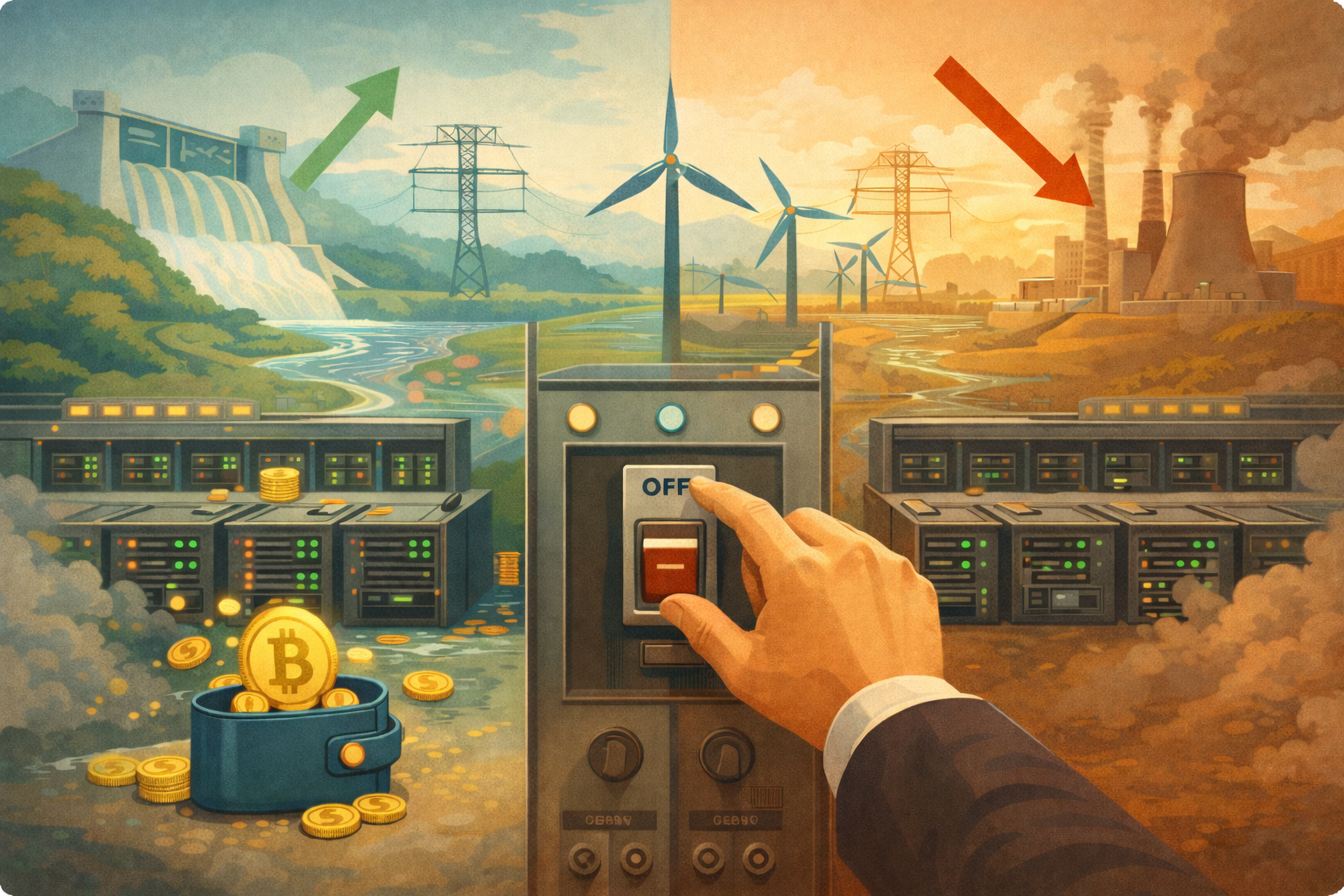
Most explanations of curtailment start with the same sentence: "Don't worry, it's temporary."
That's technically true, but misses the point entirely. Curtailment isn't just a grid inconvenience that good operators manage around. When you understand what's actually happening — and why hydro-powered facilities experience it very differently than coal or wind-heavy grids — it stops looking like downtime and starts looking like an advantage.
Here's what curtailment actually is, why it happens, and why your energy source determines whether it costs you or quietly works in your favor.
What Curtailment Actually Means
Curtailment is the intentional reduction of electricity generation or consumption to keep supply and demand balanced on the power grid.
The word comes from "curtail" — to cut something short before it reaches its planned end. You'll see it used in mortgage lending, travel insurance, and energy policy. In Bitcoin mining, it means one thing: your machines power down temporarily because the grid needs them to.
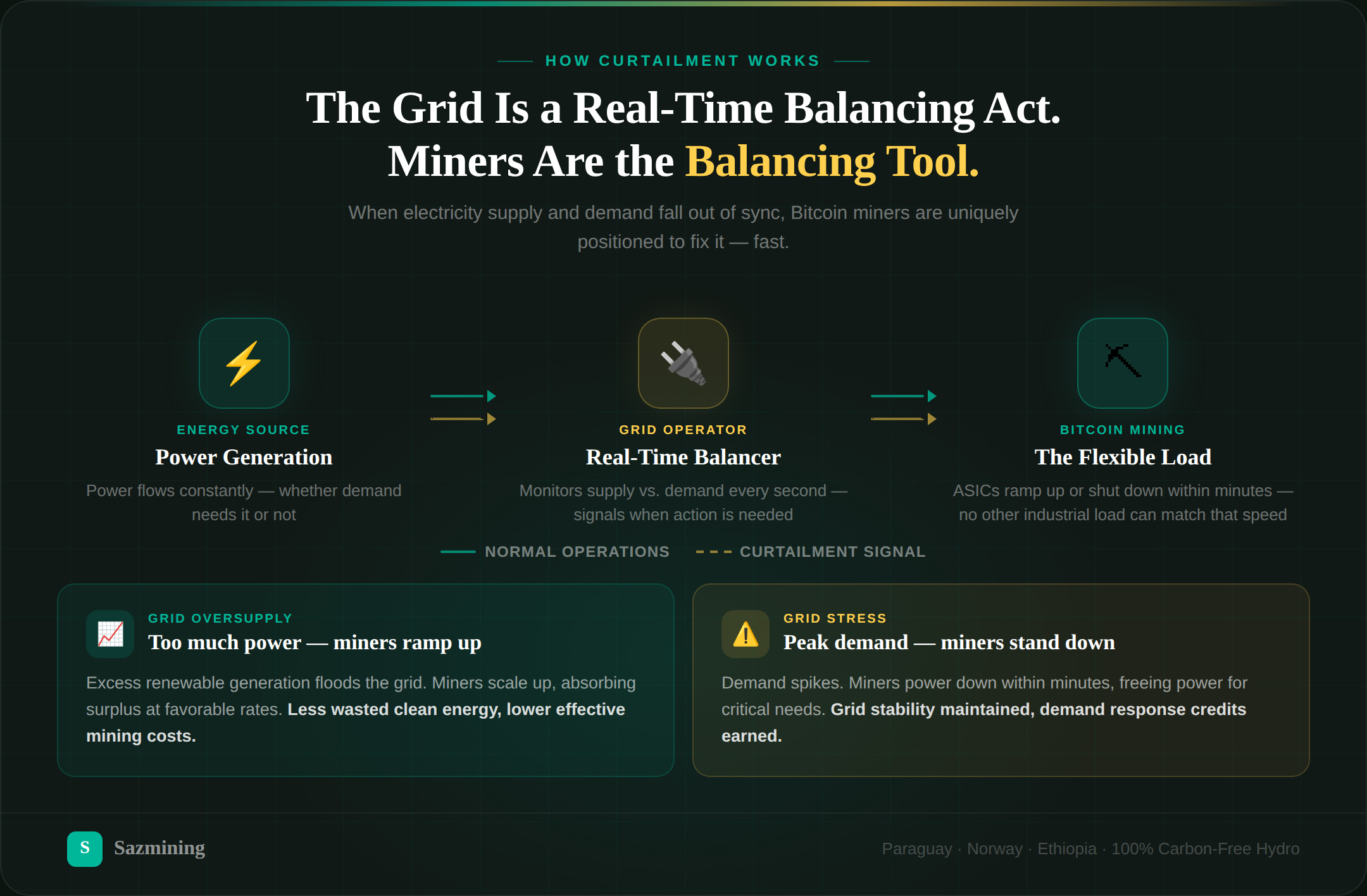
The grid operates as a real-time balancing act. Every watt generated has to match every watt consumed at every moment. When that balance tips — too much supply, too much demand, a transmission bottleneck — grid operators act fast to restore equilibrium. Bitcoin miners are one of the tools they use to do it.
There are two directions curtailment can run:
Generation curtailment happens when power plants or renewable sources dial back output because supply is outrunning demand. Excess renewable energy that can't be absorbed gets wasted.
Load curtailment happens when large energy consumers — like Bitcoin mining facilities — reduce their consumption because the grid is under stress. Miners shut down temporarily to free electricity for critical uses.
Both types matter, but for miners, load curtailment is the one that affects your operation directly.
Four Types of Curtailment in Bitcoin Mining
Not all curtailment events are the same. Understanding the difference helps you evaluate what you're actually signing up for when you choose a hosting provider.
Partial curtailment reduces your mining capacity without a full shutdown. Your rigs might run at 60% power rather than stopping completely. Operations continue at lower intensity while the grid event resolves.
Full curtailment means a complete shutdown until grid conditions stabilize. Every ASIC powers off and waits. On well-managed hydro grids, these events are infrequent and short-lived.
Voluntary curtailment is the kind that actually makes you money. When electricity prices spike to 3–4x normal rates during peak demand, pausing operations instead of mining through them cuts your electricity cost dramatically. According to Cambridge Centre for Alternative Finance data cited by Steptoe & Johnson, power purchase agreements often specifically incentivize miners to curtail and provide power back to the grid when it's most needed — and the economics can be significant. Riot Platforms, for example, booked more than $46 million in curtailment credits in the first three quarters of 2025 alone.
Involuntary curtailment is mandated by grid operators — Independent System Operators (ISOs) or Regional Transmission Organizations (RTOs) — during emergencies, extreme weather, or grid stability events. When called, large energy consumers respond. Mining facilities can comply within minutes.
Why Curtailment Happens
At its core, curtailment happens when the power grid loses balance between supply and demand. The specific triggers vary by grid type — which is exactly why your energy source matters.
Grid congestion occurs when too much power tries to flow through limited transmission infrastructure. Power might be available but physically unable to reach where it's needed.
Oversupply from renewables is the dominant cause on wind and solar-heavy grids. Wind and solar produce on nature's schedule, not the grid's. A strong afternoon wind across a low-demand Sunday can push generation well above what any grid can absorb. In some regions, up to 40% of renewable energy gets curtailed because there's simply nowhere for it to go. In California alone, monthly wind and solar curtailment has periodically exceeded 200 gigawatt-hours.
Low-demand periods create similar problems. Nights and weekends see reduced consumption. If generation stays high while demand drops, something has to give.
Emergency conditions can force rapid curtailment regardless of energy type — unexpected equipment failures, extreme weather events, sudden grid instability.
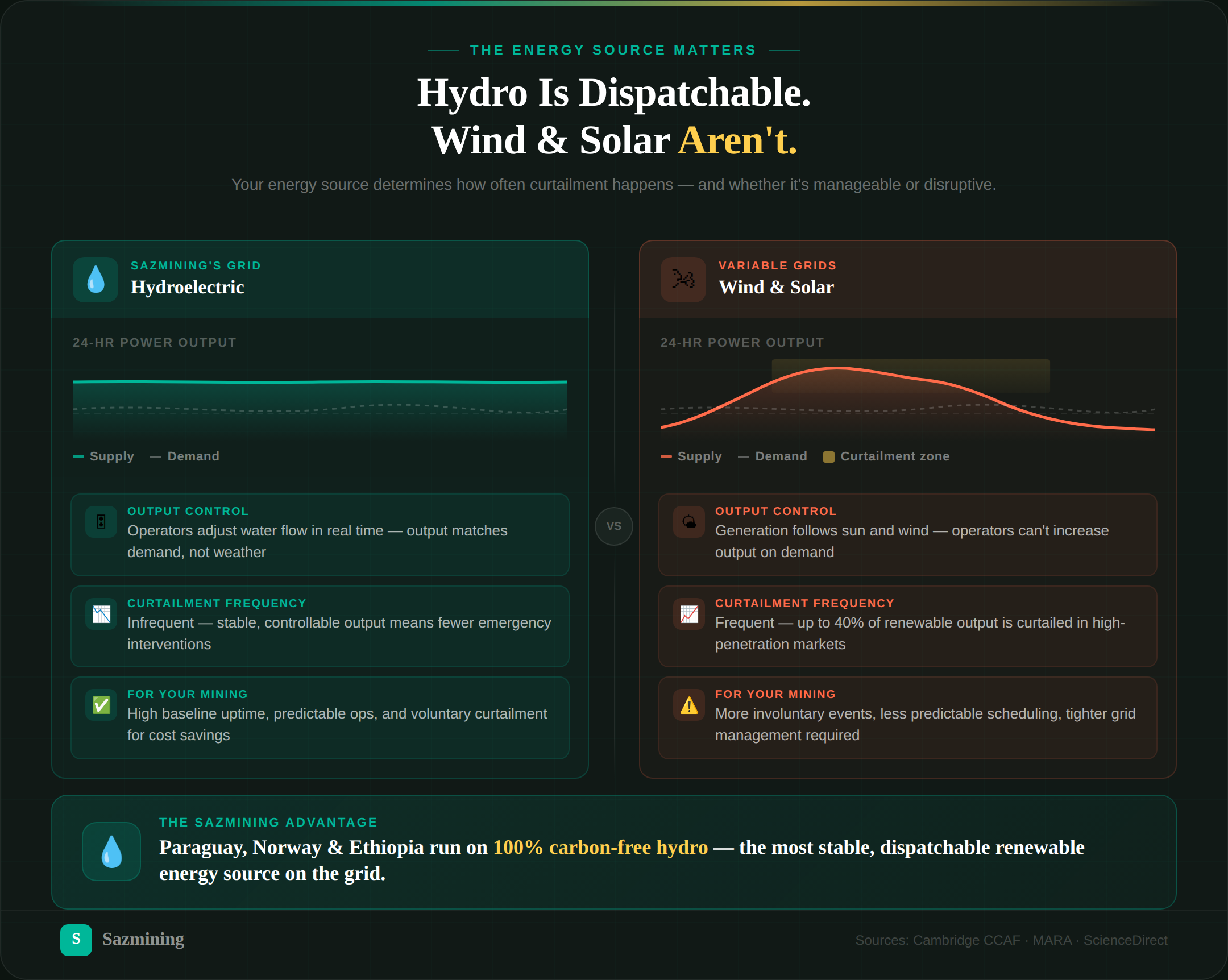
The key insight is this: not all energy sources create curtailment equally. Wind and solar are intermittent — their output swings with weather conditions and produces mismatches with demand regularly. Hydro is dispatchable — operators can control when and how much power flows, matching output to grid needs in real time. That fundamental difference changes how often curtailment events happen, and how long they last when they do.
The Hydro Difference
This is where Sazmining's energy positioning becomes directly relevant to your operation.
All three Sazmining data centers — Paraguay, Norway, and Ethiopia — run on 100% carbon-free hydroelectric power. Hydro isn't just cleaner than coal or gas. It's structurally more stable than wind and solar in ways that directly reduce the frequency and duration of curtailment events.
A peer-reviewed study published in ScienceDirect found that unlike conventional loads, mining facilities on flexible grids can curtail demand within minutes and rejoin demand response programs, making them valuable for grid stability and renewable energy integration. But the study's underlying point cuts both ways: on grids where supply is stable and predictable, those curtailment calls come less often.
Hydroelectric power plants regulate output by controlling water flow through turbines. Grid operators can increase or decrease generation within minutes to match demand changes — the same flexibility that makes miners valuable on the demand side exists on the supply side too. The result is a grid that needs less emergency load-shedding because it can self-correct more smoothly.
Wind and solar facilities don't have that lever. When the wind stops or clouds roll in, generation drops whether the grid wants it to or not. When both surge together during off-peak hours, curtailment is often the only tool available.
On a hydro-dominant grid, curtailment events tend to be infrequent, shorter, and more predictable. When they do occur, they're usually voluntary responses to momentary price spikes — the kind that save you money rather than costing you mining time.
How Curtailment Actually Affects Your Mining
The honest math on curtailment is usually more favorable than it looks on paper.
During a curtailment event, your hashrate drops and your Bitcoin production pauses. That's the visible cost. What most analyses miss are the offsets: your electricity costs drop proportionally, your hardware runs cooler, and on demand response programs, the facility may actually earn credits for curtailing — credits that feed back into keeping your hosting rates competitive.
A research paper published on SSRN by Rudd and Porter found that Bitcoin mining's participation in renewable energy grids can reduce curtailment across the broader network, provide economic benefits to renewable energy producers, and lower overall electricity prices for consumers. Mining isn't just absorbing curtailment — it's actively helping reduce it, which creates a more stable operating environment over time.
The equipment angle is real too. ASIC miners generate significant heat and run under relentless stress. Brief, periodic pauses reduce thermal load on components — particularly fans and hashboards — that degrade fastest under continuous full-power operation. A few hours of downtime per month translates to meaningfully extended hardware lifespan over a multi-year deployment.
The bottom line: curtailment is a cost when it happens unexpectedly, for extended periods, on poorly matched grids. It's a feature when it's infrequent, well-managed, and structured around energy sources that minimize the need for it in the first place.
What to Ask Any Hosting Provider About Curtailment
Not every facility handles curtailment the same way, and the differences add up quickly over months of operation. Before committing to any hosting arrangement, get clear answers on these:
What energy source powers the facility? As covered above, hydro grids carry structurally lower curtailment frequency than wind or solar-heavy grids. This isn't a minor operational detail — it's the foundation of your uptime profile.
How does billing work during curtailment? You should never pay for electricity your machines didn't consume. Any provider billing on contracted capacity rather than actual uptime is charging you for their curtailment problem, not yours.
Who initiates curtailment and under what conditions? Understand whether curtailment is driven by grid operators, the facility itself during price spikes, or both. Voluntary curtailment during price peaks is a profit-optimization tool. Involuntary curtailment during emergencies is a grid stability requirement. The frequency of each tells you a lot about the underlying energy contract and location.
Does the facility participate in demand response programs? Facilities in formal demand response programs with grid operators typically have more predictable curtailment schedules and pass financial credits back through lower base rates.
Where do your payouts go during curtailment? With Sazmining, your Bitcoin goes direct to your wallet as it's mined. There's no fund structure, no pooled payout system, no counterparty holding your earnings during a curtailment event. The moment your machines are running, the sats are moving toward your wallet.
The Bigger Picture
Curtailment isn't a niche operational topic. It's increasingly central to how the energy transition actually works.
As more renewable capacity comes online, grids need more flexible load — consumers who can scale up when there's too much power and scale down when there isn't enough. Bitcoin mining is uniquely suited to this role. Unlike a steel mill or data center running time-sensitive workloads, a Bitcoin mining facility can pause and resume without losing anything except time. That flexibility is genuinely valuable to grid operators.
The Cambridge Centre for Alternative Finance's 2025 industry report notes that Bitcoin mining's ability to scale load up or down in response to real-time grid signals is an active contributor to grid stability. That's not a talking point — it's why grid operators in Texas, Norway, and elsewhere actively court mining operations as load partners.
Sazmining's facilities operate in three countries with some of the most developed hydroelectric infrastructure in the world. Paraguay generates nearly 100% of its electricity from hydro. Norway exports surplus hydro power to neighboring countries. Ethiopia's Grand Renaissance Dam is the largest hydroelectric project in Africa. These aren't facilities tucked onto marginal energy contracts. They're integrated into grids that were built around reliable, dispatchable clean power.
When curtailment happens at a Sazmining facility, it's a managed event on a stable grid — not a symptom of energy infrastructure that was never designed for consistent industrial load.
The Bottom Line
Curtailment is a feature of how modern power grids operate, not a flaw in Bitcoin mining. The miners who fear it most are the ones on grids where it's unpredictable and frequent — wind-heavy markets, undersized transmission corridors, energy contracts that don't account for peak volatility.
On a hydro-powered grid, the story is different. Curtailment events are infrequent, short, and often voluntary — structured around price optimization rather than emergency load-shedding. When they do occur, they lower your electricity cost, extend your hardware lifespan, and contribute to the grid stability programs that keep your base rates competitive.
The question isn't whether curtailment will ever affect your operation. On any serious hosting arrangement, the answer is occasionally. The question is whether your energy source makes curtailment an infrequent, manageable event — or a recurring drag on your returns.
At Sazmining, the hydro answer to that question is built into where we chose to build → see our locations and energy sources.
This article is for educational purposes and does not constitute financial advice. Always consult qualified professionals before making investment decisions.
Sources:
- Cambridge Centre for Alternative Finance, Digital Mining Industry Report (April 2025)
- Rudd, M. & Porter, D., "Economic integration of Bitcoin mining in renewable energy and grid management," SSRN (July 2024)
- CryptoSlate, "Bitcoin is redrawing where cities and data centers rise as it competes for wasted energy, not cheap labor" (November 2025)
- ScienceDirect, "Energy, economic and environmental impacts of cryptocurrency mining" (November 2025)