

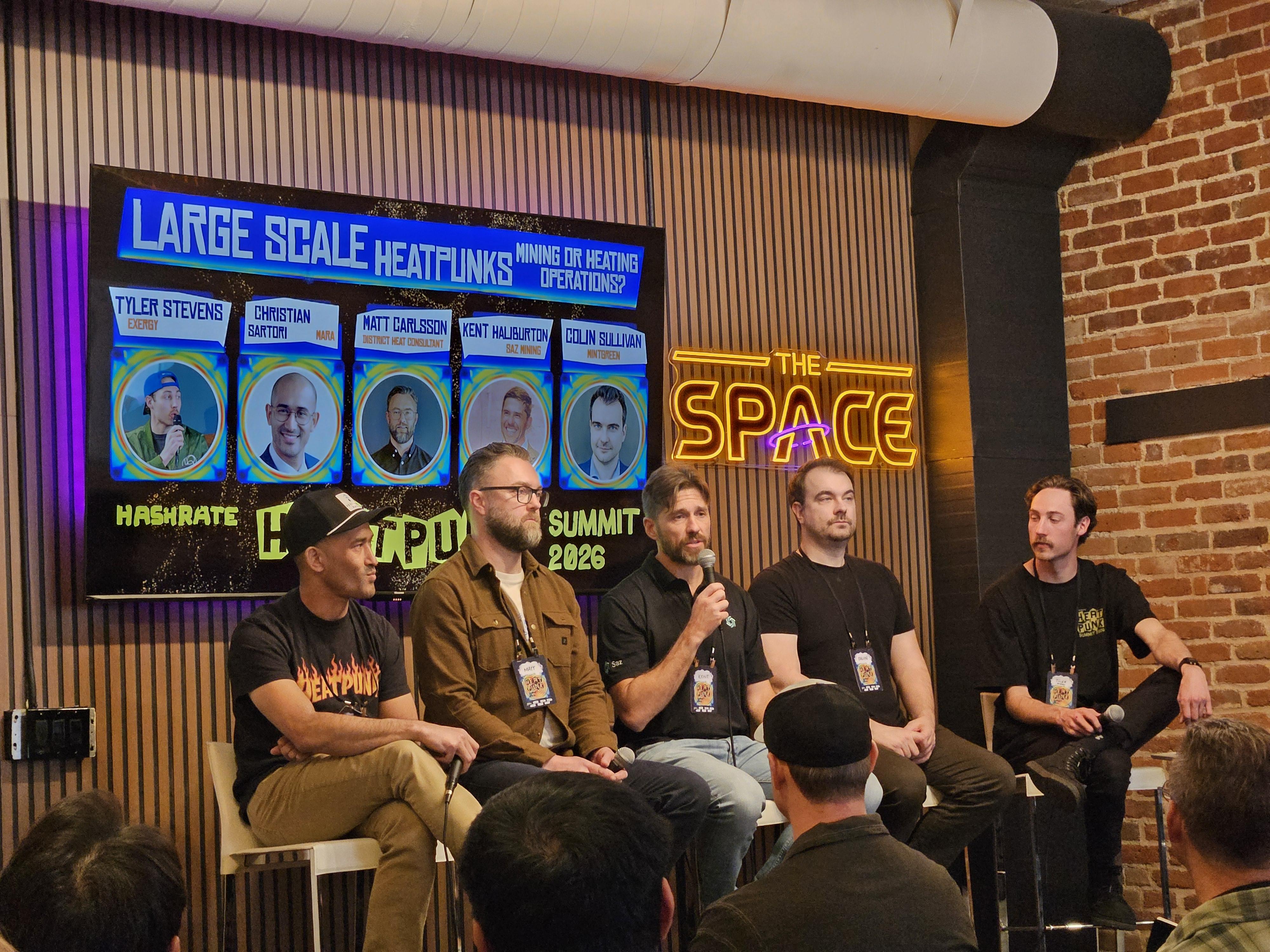
Mining operation or heating operation?
Here’s the honest answer: both, depending on what problem you are solving and who you are talking to.
At Heatpunk Summit in Denver, our CEO and co-founder Kent Halliburton put it plainly. In many places, “Bitcoin” is still a loaded word, especially when you are dealing with municipalities, property operators, or anyone who has only heard the headlines. So you do not walk in pitching “Bitcoin mining.” You lead with what is real and measurable:
A data center. Compute. And a clean replacement for the boiler they already rely on.
That framing is not marketing spin. It is how large-scale heat reuse actually gets built.
The Kirkenes proof point: a mine that replaces an oil boiler
Kent highlighted Sazmining’s 2.5 MW heat reuse site in Kirkenes, Norway as a live example of what “heatpunk” looks like at scale.
This is not “warm air in a garage.” This is an engineered heat system.
- Hydro-cooled machines run in a closed loop, moving heat through a radiator into a second loop that runs through the building.
- The building itself is a renovated hospital that became a business center, and the build-out helped eliminate an oil boiler (with backup heat still in place).
- The site operates with an SLA to deliver heat, which forces you to treat heat like a serious product, not a nice-to-have.
Here is the key line that answers the panel’s title in one shot:
For Sazmining, mining comes first, which means the heat is always there.
That creates a very “real world” operational truth: in the summer, you still need to move or dump heat, even when the building does not want it. That is why systems often include a dry cooler path.
Heat reuse is not just an efficiency play, it is jurisdiction armor
One of Kent’s most important points was strategic, not mechanical.
Sazmining chose this site because heat reuse can create regulatory resilience. If a jurisdiction turns against “Bitcoin mining,” it is harder to attack an operator that is providing a tangible service, like heating, and improving local infrastructure. Kent described it as a way to defuse jurisdictional risk as regulations around data centers shifted.
Call it what it is: heat can be a shield.
How much does heat reuse move the needle?
Kent shared two concrete data points that are useful for anyone evaluating heat reuse economics:
- Across heat reuse sites they have looked at, 20% to 50% offset is a common band.
- For Kirkenes specifically, the heat offsets about 30% (as a site-level data point).
No, this does not mean every mining site suddenly becomes a district heating utility. It means the right projects can turn “waste” into a second product that helps you survive thinner mining margins.
Kent tied that directly to the bigger trend: as hash rate rises and mining margins get squeezed, operators will need every durable advantage they can stack.
The hard part is not mining, it is control systems
If you want the unglamorous truth from the panel, it is this:
Large-scale heatpunk is still early. The bottleneck is controls, automation, and integration.
Kent described the industry as still being in “tinkering land,” where each deployment teaches you how to automate routing heat in a more stable way. Heat-side control is often more complex than the mining operation itself.
He also mentioned their Norway partner is on roughly their 19th data center of this type and is still iterating, which tells you how new the playbook still is.
The good news: Kent expects standardization. The bad news: we are not fully there yet.
Why Europe is leading the “large-scale heatpunk” wave
Kent made a pointed observation that matches what many builders are seeing on the ground:
Europe’s electricity prices are high, regulation is tighter, and that combination forces innovation. That is why industrial-scale heat reuse models are emerging from the EU, and why heat reuse is increasingly “necessary” there to operate at all.
Whether the same model becomes the default everywhere is still an open question. But the direction is clear: heat reuse is moving from novelty to infrastructure.
Ready to heat up your Bitcoin acquisition method? --> Browse Saz Rigs today