

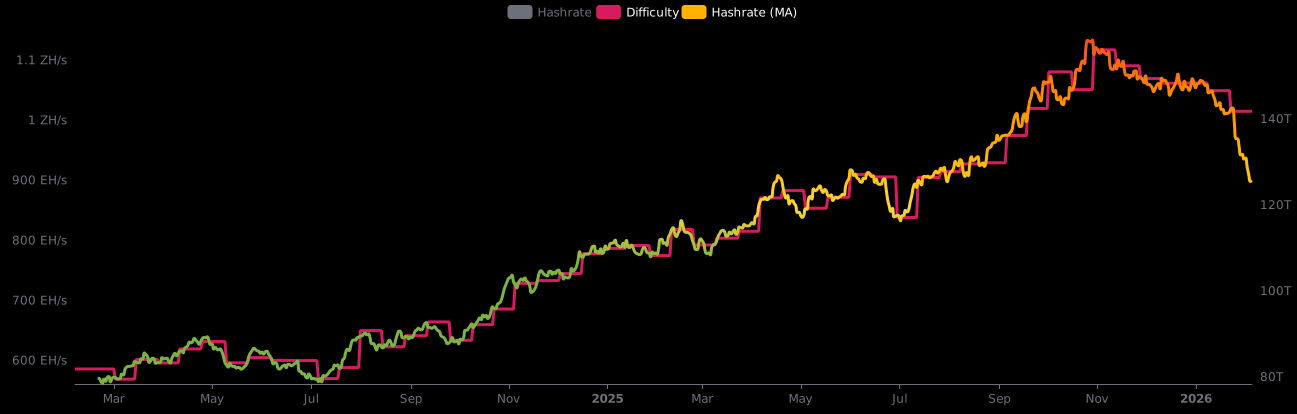
Bitcoin is currently tracking toward a negative difficulty adjustment of about -13-15%.
That number can move between now and the retarget, but the direction is the story: difficulty is projected to drop hard.
And if you’re a miner (or you’re about to get off zero), this is one of the most straightforward tailwinds the network can hand you:
Lower difficulty = more sats earned per unit of hashrate.
What the network is currently saying (right now)
From mempool’s current mining stats:
- Projected difficulty change: -13.44% (adjusts slightly depending on the day)
- Blocks remaining until retarget: 364 (at time of publication)
- Estimated retarget time: Feb 7, 2026, around 5:48 PM EST (estimate)
- Average block time this period: ~11.5 minutes
- Current network difficulty: ~141.67T
- Current estimated hashrate (recent): ~900.9 EH/s
Important note: This estimate updates as new blocks come in. Treat it like a weather forecast, not a prophecy.

Quick refresher: what a difficulty adjustment actually does
Bitcoin adjusts difficulty every 2,016 blocks to keep blocks landing around the ~10-minute target.
- If blocks are coming in slow (like they are now), difficulty adjusts down.
- If blocks are coming in fast, difficulty adjusts up.
Right now, the network is averaging ~11.5 minutes per block this epoch. That is why the next adjustment is projected negative.
Why a negative difficulty adjustment is a gift for miners
Here’s the simplest way to say it:
When difficulty drops, the network is effectively saying, “It takes fewer hashes to find blocks than it did last epoch.”
That means for a miner with the same machine and uptime, your expected sats earned per TH goes up, all else equal.
How much more sats are we talking?
Difficulty changes don’t map 1:1 to sats. The output per TH/day scales roughly inversely with difficulty.
So if difficulty is projected to drop -13.19%, then expected sats per TH/day rises by about:
- 1 / (1 - 0.1319) ≈ 1.15x, or roughly ~15% more sats per TH/day (estimate).
The exact realized gain depends on fees, pool variance, uptime, and what the network does next, but directionally: this is a meaningful tailwind.
What’s causing the drop?
Negative adjustments typically show up when some combination of these happens:
- Less efficient miners unplug
- Machines get curtailed (power pricing, weather, grid events)
- Operators reduce exposure during rough price action
- Hashrate dips, blocks slow, difficulty resets
Right now, mempool’s data shows a recent estimated hashrate around ~900 EH/s, and the protocol is responding accordingly.
The miner playbook when difficulty is dropping
This part is boring, which is why it works:
- Be plugged in before the retarget
If you wait until after the adjustment, you miss part of the window. - Prioritize uptime and stability
The network rewards consistency, not vibes. - Make sure your setup matches your reality
Power assumptions, hosting, payout method, pool choice, and expectations.
This is exactly why we push consultations. Not because mining is complicated, but because it’s easy to make one “small” decision that quietly nukes your results.
Want to take advantage of this with a real plan?
If you want help getting off zero (or optimizing what you already have), book a free call with a Sazmining advisor:
https://www.sazmining.com/free-consultation
We’ll help you map:
- What this projected difficulty drop means for your specific setup
- What rig makes sense for your goals
- The fastest path to getting plugged in with confidence
FAQ
When is the next difficulty adjustment?
Mempool currently estimates the retarget for Feb 7, 2026, around 5:48 PM MST.
Is the drop really 15%?
Right now, mempool’s estimate is -13.19%, and it can drift up or down as blocks come in.
Does lower difficulty guarantee more sats?
It increases expected sats per TH assuming similar network conditions, but your actual results depend on uptime, fees, pool variance, and how hashrate responds after the retarget.